Page loading ... Please wait.
 
Baking & Dessert Recipes & Photos
 
Web Joyofbaking.com


About Us

Substitutions

Ingredients

Glossary

Conversions


Home

Recipe Index

New Recipes

Breakfast & Brunch

Bars & Squares

Cakes

Cookies

Pies & Tarts

Pumpkin Recipes

Thanksgiving Baking

Apple Recipes

Comfort Foods

Biscotti

Quick Breads

Muffins

Scones

Shortbreads

Christmas Baking

Christmas Candy

Christmas Cookies

English Tea Party

Trifles

Blueberry Recipes

Lemon Recipes

Strawberry Recipes

Valentine's Day Desserts

Easter Baking

Ice Creams & Ices

Baking History

Bibliography

Amaretti Cookies Recipe

Printer Friendly Page

Amaretti Cookies Recipe & Photo

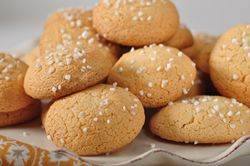
Amaretti, pronounced "am-ah-REHT-tee", is the Italian name for macaroons, which means little bitter things. Crisp and crunchy on the outside and soft inside, these small, domed shaped cookies originated in Venice Italy during the Renaissance period. Amaretti cookies are made from either ground almonds or almond paste, along with sugar and egg whites and can be flavored with chocolate or liqueurs. Oftentimes, two baked cookies are sandwiched together with ganache, buttercream or jam. Traditionally these cookies were served with a sweet dessert wine or liqueur, but they are also wonderful with a bowl of ice cream, sherbets, or mousses.  Another favorite way to use these cookies is to finely ground them and then add them to desserts (such as trifles) for added texture and flavor. 

For this Amaretti recipe I have used almond paste which is a combination of equal parts ground blanched almonds and sugar, mixed with glucose, corn syrup or egg whites. It has a pliable yet grainy texture with a sweet almond flavor.  Sold in cans or tubes, I recommend using the canned variety as I think it has a superior taste. As a side note, almond paste is also used in pastry making and confectionery to cover cakes and pastries, as well as forming into different shapes and figures. Any unused portions of almost paste can be wrapped in plastic and refrigerated or else frozen. 

This dough can be made in an electric mixer or a food processor. I have given instructions for both methods.


Preheat oven to 375 degrees F (190 degrees C) and line two baking sheets with parchment paper.  Have ready a pastry bag fitted with a 1/2 inch (1.25 cm) plain tip.

Using Food Processor:  Break the almond paste into small pieces and place in bowl of food processor,  with the sugar.  Pulse  until the mixture is very fine.  Add the egg whites in three additions, processing well after each addition.  Continue processing the dough until very smooth (about one minute). 

Using Electric Mixer:  Break the almond paste into small pieces and place in bowl of electric mixer along with the sugar.  Mix on low speed until very fine.  Add the egg whites in three additions, mixing well after each addition.  Continue mixing the dough until very smooth, about 3 to 4 minutes.

Fill the pastry bag with the almond mixture.  Pipe 1 1/2 inch (3.75 cm) mounds onto the parchment paper, spacing about 1 inch (2.5 cm) apart.  After you have filled the baking sheet with cookie mounds, take a damp paper towel and lightly press the top of each cookie to smooth out the surface (you want to smooth out the tip of dough at the top of each cookie caused from piping).  Lightly sprinkle a little sugar on top of each cookie.

Bake for 15 minutes, or until the cookies have risen, are a deep golden color and have tiny cracks.  Remove from the oven and place baking pan on a rack to cool.  When cool gently peel cookies from parchment.  If they stick to parchment, turn the paper over, take a damp paper towel and gently wipe the bottom of the parchment paper to loosen the cookie.

Makes 3 1/2 dozen.

Adapted from Great Italian Desserts by Nick Malgieri

8 ounces (225 grams) canned almond paste

1 cup (200 grams) superfine or castor sugar

2 large (60 grams) egg whites

Extra granulated white sugar for dusting cookies

Note:  Make your own superfine sugar by processing regular granulated white sugar in your food processor for about 30 seconds or until sugar is ground very fine. 


s


Save This Page to del.icio.us


A baking resource on the Internet since 1997

Contact Us   Privacy Policy

All content on this site is either original or has been significantly modified and changed from its credited original source.  Use of materials on Joyofbaking.com is entirely at the risk of the user and Joyofbaking.com or Stephanie Jaworski will not be responsible for any damages directly or indirectly resulting from the use.

This website and the contents thereof are not endorsed or sponsored by the owner of the "Joy of Cooking" series of books or its publisher Simon & Schuster, Inc.

Content in any form may not be copied or used without written permission of Stephanie Jaworski, Joyofbaking.com.  Students and non profit educators may use content without permission with proper credit. 

Copyright  1997 to 2008 Stephanie Jaworski