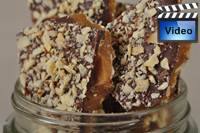
The sweet buttery flavor of
this Butter crunch Toffee is so good when covered with a layer of
chocolate and toasted almonds. Perfect for the holidays.
more
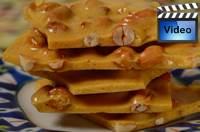
Peanut Brittle has a
delicious sweet buttery flavor and hard and crunchy texture that
seems to literally melt in your mouth.
more
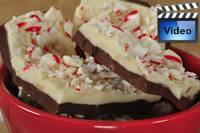
Peppermint Bark is
composed of two layers of chocolate; one dark one white, that are
topped with crushed candy canes. more
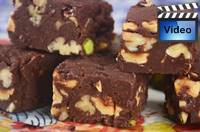
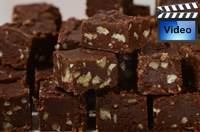
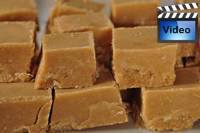
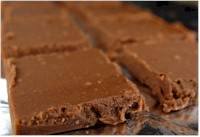
Simple chocolate fudge is
just that, simple to make. It is also loaded with nuts and is creamy
smooth with a nice chocolate flavor. more
Chocolate Marshmallow Fudge
is a smooth and creamy fudge that contains marshmallow cream.
more
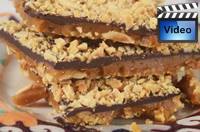
This crunchy Toffee, also
known as Butter, Buttercrunch, or English Toffee, has a layer of buttery
smooth toffee smothered in dark chocolate and toasted almonds.
more
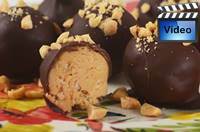
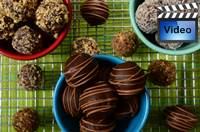
These no bake
peanut butter balls contain rice cereal which adds a nice
crispy crunch. They have a
shiny coating of dark chocolate with a sprinkling of chopped
peanuts. more
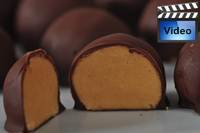
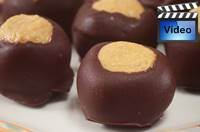
Peanut Butter Balls have a
lovely coating of chocolate with a smooth and creamy filling that is
almost fudge-like in texture. more
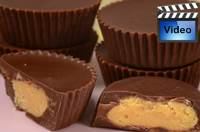
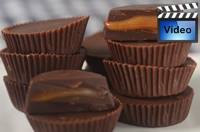
Peanut Butter Cups have a
shell of milk and semi sweet chocolates and a smooth and creamy peanut
butter center. more
Rum balls are the
perfect adult indulgence for as their name implies, 'rum' balls
contain rum and since we do not bake these cookies the alcohol taste
and content are not lost during baking. more
Bourbon Balls
are a sweet and chewy,
no-bake confection made from a combination of crushed vanilla wafers,
confectioners sugar, cocoa powder, chopped pecans or walnuts, held
together with a little corn syrup and bourbon.
more
Fruit and Nuts Balls
(Sugarplums) are a delightful mixture of nuts and dried fruits binded
together with a splash of Grand Marnier or orange juice.
more
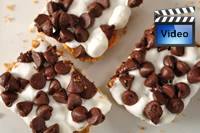
S'mores are deliciously
sweet and gooey. They take roasted marshmallows and pieces of chocolate
and sandwiches them between two graham crackers.
more
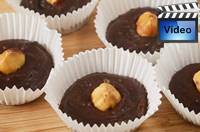
Hazelnut Ganache Cups
are a delicious mixture of chocolate, cream, and finely chopped hazelnuts.
Each ganache cup is garnished
with a whole toasted nut. more
White Chocolate
Haystacks are a no bake candy. They are small mounds of peanuts and
pretzels covered in sweet white chocolate.
more
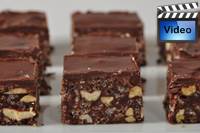
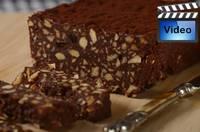
This wonderful
chocolate cake is like making your own chocolate bar. No baking
is involved and it contains only four ingredients; chocolate, butter, nuts,
and digestive biscuits. more
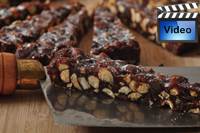
Bite into a slice of
Panforte and you may be surprised to find how chewy it is. This chewy
texture comes from mixing the fruit, nuts, spices, and flour with a
boiled syrup made from sugar and honey. more
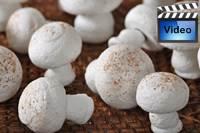
Meringue Mushrooms are
made with a meringue that is piped into shapes that look like mushroom 'caps' and
'stems'. They are sweet tasting with a melt-in-your-mouth
texture. more
White Chocolate Candy Bars
are a lovely combination of melted white chocolate, dried fruits, orange
juice and zest, and chopped nuts.
more
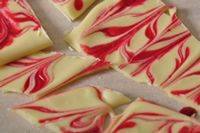
This brittle is nice to eat
alone or as a decoration on a plated dessert. Just white chocolate and
raspberry puree are needed to make this delicious candy.
more
This delicious candy-like
square is made with rice cereal, melted marshmallows, and margarine.
more
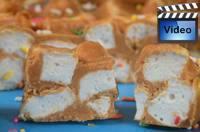
Rocky Road consists of
white chunks of soft and spongy marshmallow together with crunchy
peanuts, all enrobed in a silky smooth dark chocolate.
more
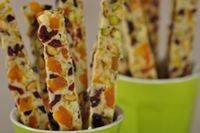
Pumpkin Seed Brittle is a
delicious confection that is full of toasted pumpkin seeds encased in a
cooked sugar syrup. Pumpkin Seed Brittle is hard and brittle, yet
crunchy and sweet. more
This delicious Chocolate
Bark contains only two ingredients; dark chocolate and toasted whole
almonds. Great for gift giving. more
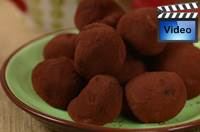
Chocolate Truffles
are a smooth and creamy mixture of dark
chocolate and cream. They are formed into rounds and often rolled in
cocoa powder. more
This Old Fashioned
Chocolate Fudge is made by boiling sugar syrup to the soft ball
stage. It is often described as a "grained caramel". Delicious. more
A delicious candy.
It has a chocolate shell made from both semi sweet and milk
chocolate. Inside you will find a rich and creamy caramel.
more
Candy. The very word conjures up so many wonderful images: caramels, lollipops,
chocolate covered nuts, marshmallows, fudge, taffy, chewing gum, citrus rinds,
cotton candy, and candy bars. Carole Bloom in her "The International Dictionary
of Desserts, Pastries.
Confections" defines 'candy' as any of a variety of
confections made with sugar and often combined with chocolate, fruit, and/or
nuts.
Of course, you can buy all the candy I mentioned above, but making
your own is so much fun and it gives you a real sense of accomplishment. Eyes
light up when you present someone with a homemade batch of caramels or
fudge. If you are a little tentative about candy making, start with
easy recipes; things like chocolate truffles, fruit and nut balls,
hazelnut Ganache cups, white chocolate candy bars, or peanut butter
balls. All of these recipes just require mixing ingredients together.
Then, when you feel more confident, try the recipes (buttercrunch
toffee, caramels, caramel corn, fudge, marshmallows, and peanut brittle)
that use cooked sugar. Cooked sugar is where sugar, along with water and
other ingredients, are boiled to a certain temperature. As the sugar
mixture boils, water evaporates from the mixture, making a dense syrup.
The longer the mixture boils, the denser the syrup will be. There are
various stages of Cooked Sugar: thread, soft ball, firm ball, hard ball,
soft crack and hard crack. (See
'Stages of Cooked Sugar' Table) Each stage has a corresponding
temperature range, and at each stage, when you drop a spoonful of the
cooked sugar in cold water, it will behave in a certain way. How it
behaves at each stage also tells us how the candy will eventually set.
For example, at the soft ball stage (234 - 240 degrees F) (112 - 115
degrees C) the sugar, when a little is dropped in cold water, will be a
soft, sticky ball that is perfect for making caramels, fudge and butter
creams. However, this water test can be tricky and oftentimes, for the
inexperienced candy maker, by the time you do the water test and figure
out what stage you are at, the sugar has cooked too much. Luckily there
is another way to tell the stage of the cooked sugar. And that is with
an accurate candy thermometer. This tool eliminates any guesswork.
Speaking of
candy thermometers. It is very important to buy a good
mercury or digital candy thermometer with a metal clip so you can fasten it to
the side of a heavy saucepan. The thermometer should measure, in 2 degree
increments, from 100 - 400 degrees F (35 - 200 degrees C in 1 degree
increments). When using a candy thermometer make sure the bulb of the thermometer
does not rest on the bottom of the saucepan as this can cause an inaccurate
temperature reading. It is also important to read the temperature at eye level
and you may have to wipe the steam off the thermometer first in order to read
the numbers. If you think your candy thermometer may be inaccurate, you can test
its' accuracy by placing it in a saucepan of boiling water. The temperature
should read 212 degrees F (100 degrees C). If you find your thermometer is off
by a degree or two, simply adjust your recipe to take this into account. Another
thing about candy thermometers is that they are fragile so after each use place
in hot water (not cold) to dissolve the sugar coating. Never place a hot
thermometer into cold water as this can cause it to break. And be sure to store
your thermometer away from other kitchen utensils so it won't get banged around.
Lastly, cleaning the dirty saucepan can be a problem. The best way to remove all that
hard caramelized sugar is to fill the saucepan with water and bring it to a
boil. Turn off the heat and let it sit until the sugar dissolves.
There are a few other things to
know when making candy. One is that the weather conditions are important. Heat
and humidity can negatively affect the outcome of your candy. So it is best to
make candy on a cool dry day or have adequate air conditioning. Also, before you begin making any candy
make sure you are familiar with the recipe, have all your equipment ready, and
all your ingredients
measured and within easy reach. Now, this is the important part. Sugar Crystallization
is the biggest problem in candy making as it will turn a smooth sugar syrup into
a grainy mess. This is caused by the formation of sugar crystals which can start
a chain reaction of crystallization (the process of sugar particles clinging
together) that makes the mixture grainy. So, to prevent this from happening, stir the ingredients constantly until they reach the boiling point
as this ensures that the sugar has completely melted. Then, as per your recipe's
instructions, you either brush down the sides of the saucepan with a heatproof
pastry brush that has been dipped in warm water to remove any sugar crystals
that may have formed on the sides of the saucepan, or you place a tight fitting
lid on the saucepan and let the sugar syrup boil this way for a few minutes
(this allows steam to form which then condenses and washes off any sugar
crystals that have attached themselves to the sides of the saucepan). Then
remove the lid and clamp a candy thermometer to the side of the saucepan.
Normally the mixture is not stirred as it cooks, as introducing a wooden spoon
to the mixture as it boils can cause crystallization. But follow your recipe's
instructions as sometimes you do need to stir the mixture. One reason you can do
this is that there are ingredients; such as corn syrup, honey, fat, lemon juice
and/or cream of tartar that help to inhibit crystallization.
Sources:
Amendola, Joseph & Lundberg,
Donald. 'Understanding Baking Second Edition'. Van Nostrand Reinhold. New
York. 1992.
Bloom, Carole. 'The
International Dictionary of Desserts, Pastries, and Confections'. Hearst
Books. New York: 1995.
Friberg, Bo. 'The Professional
Pastry Chef'. Van Nostrand Reinhold. New York: 1996.
Greweling, Peter P. 'Chocolates
& Confections'. John Wiley & Sons, Inc. New York: 2007.
Rinsky, Glenn & Rinsky, Laura
Halpin. 'The Pastry Chef's Companion'. John Wiley & Sons, Inc. Hoboken
New Jersey: 2009.
Rodgers, Rick. 'Christmas 101'.
William Morrow. New York: 2007.
Rombauer, Irma & Becker, Marion
Rombauer & Becker, Ethan. 'The All New All Purpose Joy of Cooking'.
Scribner. New York: 1997.
Rice Krispies Treats®
is a trademark of Kellogg's NA Co.
Use of materials on
all pages on the domains Joyofbaking.com,
the Joyofbaking.com Facebook
Page, the
Joyofbaking1 YouTube
Channel and any emails sent from @joyofbaking.com
are
entirely at the risk of the user and their owner, iFood Media LLC
will not be responsible for any damages directly or indirectly resulting
from the use.
References
cited may include a link to purchase the referenced book or item on Amazon.com.
Joyofbaking.com receives a commission on any purchases resulting from these
links.
This
website and the contents are not endorsed or sponsored by the owner of the
"Joy of Cooking" series of books or its publisher Simon & Schuster, Inc.
and is not related to the "Joy the Baker" books and website.
Video icons by Asher.
Content in any form may
not be copied or used without written permission of Stephanie Jaworski,
Joyofbaking.com. Students and non profit educators may use content without
permission with proper credit.