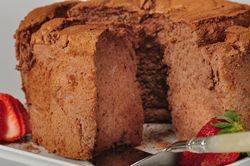
ngel Food Cakes or
Angel Cakes are so named because of their airy lightness
and are said to be the "food of the angels". They contain no egg yolks, fat, or
even
baking powder and its volume comes from
stiffly beaten egg whites. Angel Food Cakes do contain more sugar than other sponge cakes and
this is to support and stabilize the large amount of egg whites. Cake flour,
which is a low gluten flour, is used to
give the cake its delicate texture.
Angel food cakes use their own special pan which Greg Patent in "Baking
in America" tells us was invented in the late 1800s. He says the
first tube pans were, in fact, square and the "central tube assured the even
distribution of heat to the batter, resulting in cakes that cooked more
quickly."
The pan is left ungreased so the batter can cling to the sides of the
pan as it bakes and allows it to reach its full volume.
Unlike most cakes that are simply placed on a wire rack to cool, angel
food cakes
are immediately inverted so the baked cake will maintain its volume and
to keep it from shrinking as it cools.
This recipe comes from Rose Levy Berenbaum's "Cake Bible" and she says
that the cocoa powder used in this recipe "does wonders to temper the
sweetness". Although dissolving cocoa powder in hot water is
usually done to intensity its flavor, this cake does not end up with a
strong chocolate flavor.
You may be surprised at how many egg whites are in an angel food cake,
but if we look at cake recipes around the time of its invention, circa
1870, we find that all cake recipes used lots of eggs.
Waverley Root in "Eating in America A History" tells how in Mrs. J.
Chadwick's 1853 "Home Cookery" she calls for 32 egg yolks for just one
cake. He also cites Mrs. Horace Mann's "Christianity in the
Kitchen" (1861) as calling for 20 eggs in one cake that had to be beaten
for about three hours. It is a good thing that at about the same
time the angel food cake was invented the rotary egg beater came along which eliminated the long and laborious hand beating of
batters.
There is always the problem of what to do with all the leftover yolks.
You can freeze egg yolks for later use. Sharon Tyler Herbst in
"The Food Lover's Tiptionary" advises "adding 1/8 teaspoon salt or 1 1/2
teaspoons sugar to each 1/4 cup of yolks (4 yolks) and beat to combine.
This inhibits gelatin and whether you add salt or sugar depends on how
you will be using the yolks later on." They can be frozen for up
to three months or else placed in the refrigerator for a few days. Some
recipes that use only egg yolks are:
Vanilla Ice Cream,
Chocolate Ice Cream,
Raspberry Swirl Ice Cream, Creme Anglaise (Custard Sauce),
Crème
Patissiere (Pastry Cream), and the
Yellow Butter Cake.
Preheat oven to 350
degrees F (177 degrees C) and place rack in center of oven. Have ready a
10 inch (25 cm) two piece angel food cake (tube) pan.
Separate 16 eggs, whites in one
bowl and yolks in another. Cover whites with plastic wrap and bring to
room temperature (about 30 minutes). Cover yolks and store in refrigerator
or freezer for another use.
In a small measuring cup or
bowl combine the cocoa powder and boiling water and stir until smooth.
Stir or whisk in the vanilla extract. Set aside.
In another bowl whisk together
3/4 cup (150 grams) granulated white sugar, the sifted cake flour, and the salt.
Set aside.
In a large mixing bowl, with
the whisk attachment, beat the egg whites until foamy. Add the cream of
tartar and continue to beat until soft peaks form. Gradually beat in the
remaining 1 cup (200 grams) granulated white sugar until stiff peaks form.
Remove 1 cup of the beaten egg
whites and whisk it into the cocoa powder mixture to lighten it.
To the remaining egg whites,
gradually sift the flour mixture over the egg whites (about 1/4 cup at a time)
and gently but quickly fold the flour into the egg whites. You can use a
large wire whisk, large rubber spatula or a angel food cake folder for this
task. Once you have incorporated the flour mixture into the egg whites
fold in the cocoa powder mixture. (It is important not to overmix the
batter or it will deflate.)
Pour the batter into the pan
(will be almost full) and run a metal spatula or knife through the batter to get
rid of any air pockets. Smooth the top and bake in the oven for about 40 -
45 minutes. It is done when a wooden skewer inserted in the center of the
cake comes out clean and the cake springs back when gently pressed. The
top of the cake will have cracks.
Immediately upon removing from
the oven invert the pan. Suspend the pan by placing the inner tube on the
top of a soda or wine bottle. Allow the cake to cool for about 1 1/2
hours.
When completely cool, run a
metal spatula or knife around the sides of the pan to loosen
the cake and then remove the cake from the pan. Next, run a metal spatula or knife along the bottom and center core
of the pan and remove. Place onto a serving plate.
The cake will keep covered for
a few days at room temperature or for about a week in the refrigerator.
This cake can be eaten alone
with just a dusting of cocoa powder or confectioners' sugar. Is also wonderful
with fresh berries and softly whipped cream. Another idea is to serve with
ice cream, strawberry or
raspberry puree, or
chocolate sauce.
Serves 12
Sources:
Beranbaum, Rose
Levy. The Cake Bible. New York: William Morrow and Company, Inc.,
1988.
Marian, John F.
The Dictionary of American Food & Drink, New Haven and New York:
Ticknor & Fields, 1983.
McFeely, Mary
Drake. Can She Bake a Cherry Pie?. Amherst: University of
Massachusetts Press, 2000.
Patent,
Greg. Baking in America. New York: Houghton Mifflin Company, 2002.
Root, Waverley &
de Rochemont, Richard. Eating in America A History. New York:
William Morrow and Company, Inc. 1976.
Note: Cream of
Tartar is tartaric acid and is a fine white crystalline acid salt which
is a by-product of the wine-making industry.
It is used when whipping egg whites to stabilize them and to prevent
over beating and the whites drying out.
All content on this site is
either original or has been significantly modified and changed from its
credited original source. Use of materials on Joyofbaking.com is
entirely at the risk of the user and Joyofbaking.com or Stephanie Jaworski
will not be responsible for any damages directly or indirectly resulting
from the use.
This
website and the contents thereof are not endorsed or sponsored by the owner
of the "Joy of Cooking" series of books or its publisher Simon & Schuster,
Inc.
Content in any form may
not be copied or used without written permission of Stephanie Jaworski,
Joyofbaking.com. Students and non profit educators may use content without
permission with proper credit.