Page loading ... Please wait.
Baking & Dessert Recipes & Pictures

breakfast & brunch bars & squares biscotti recipes shortbread recipes comfort foods healthy baking
about us
thanksgiving baking
substitutions
ingredients
glossary
conversions
christmas baking
christmas cookies
christmas candy
english tea party
quick breads
chocolate recipes
pumpkin recipes
apple recipes
cranberry recipes
blueberry recipes
lemon recipes
strawberry recipes
trifle recipes
ice cream recipes
pudding recipes
easter baking
valentine's baking
halloween baking
baking history
bibliography

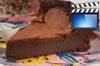
Chocolate Hazelnut Torte Recipe

Printer Friendly Page

Chocolate Hazelnut Torte Recipe

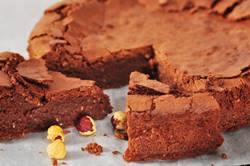
When Alice Medrich's excellent book 'Cocolat' first came out I had never tasted, let alone baked, a chocolate torte.  After making one of these European style cakes I found it had a wonderfully intense chocolate flavor and moist texture that was very different from the butter cakes I grew up eating.  What makes these cakes so different is that they contain little or no flour.  They use good quality chocolate and butter and their volume comes from the beating of the eggs (yolks and whites separately) with sugar.  While the cake rises during baking, don't worry when it collapses as it cools, leaving a crust that is cracked and sunken.  This is how it should be and all you need to do is to press the pieces back into the cake as it cools. 

The recipe I have chosen to feature here takes your basic chocolate torte one step further by adding hazelnuts.  Hazelnuts and chocolate are, of course, wonderful together and are enjoyed around the world.  Testament to their popularity is the fact that Nutella (that popular spread made with sugar, vegetable oil, hazelnuts, and cocoa powder) "out sells all the world's brands of peanut butter put together" ('The Chocolate Connoisseur' by Chloe Doutre-Roussel).  While this cake can be eaten plain, I like it with a coating of ganache.  For the uninitiated, Ganache is a French term referring to a smooth mixture of chopped chocolate and heavy cream.  When poured over a cake it gives it a lovely smooth and shiny glaze.  The important thing to remember is to use a good quality chocolate, both for the cake and ganache, but make sure it is one you would enjoy eating out of hand.  The reason I mention this is because some of the bittersweet chocolates that are highly recommended by chefs and food writers may be a little too bitter tasting for some people's palates.  So taste and compare a few brands for a flavor you like before making the cake.  Now, this is the perfect cake for a celebration or dinner party as it can be made several days in advance.  In fact, it is better after a day or two when the flavors have had time to soften.  This will definitely become a favorite. 


To toast nuts:  Preheat oven to 350 degrees F (177 degrees C) and place rack in center of oven.  Place the hazelnuts on a baking sheet and bake for about 15 minutes or until nuts are brown and fragrant and the skins start to peel away from the nut.  Remove from oven and place the nuts in a clean dish towel.  Roll up the towel and let the nuts 'steam' for about five minutes and then rub the nuts to remove the skins.  Let cool.

To make ground hazelnuts:  Once the hazelnuts have completely cooled, place in a food processor, along with the flour and salt, and process until hazelnuts are finely ground.  Set aside.

To make Torte:  Increase the oven temperature to 375 degrees F (190 degrees C).  Line the bottom of an 8 x 3 inch (20 x 9 cm) round cake pan or springform pan with parchment paper.

Separate the eggs while they are still cold, placing the yolks in one bowl and the whites in another.  Cover the two bowls with plastic wrap and allow the eggs to come to room temperature before using (about 30 minutes).

Meanwhile, in a heatproof bowl, over a saucepan of simmering water, melt the chocolate and butter.  Remove from heat and set aside.  

In the bowl of your electric mixer, beat the egg yolks with 1/2 cup (100 grams) sugar until pale and thick (about 3 - 5 minutes). (When you raise the beaters the mixture will slowly fall back into the bowl in a ribbon.)  Beat in the vanilla extract.  With a rubber spatula gently fold in the warm chocolate mixture and the nut and flour mixture.  Set aside while you whip the egg whites.

In a clean bowl, with the whisk attachment, beat the egg whites, at medium speed, until foamy and then add the cream of tartar.  Continue beating until soft peaks form.  Gradually add the remaining 1/4 cup (50 grams) sugar, beating at high speed until stiff but not dry.  With a large spatula or whisk, fold a small amount of the whites into the chocolate batter to lighten it.  Quickly fold in the remaining whites.  Do not over mix or the batter will deflate.  Pour the mixture into the prepared pan and smooth the top.  Bake for 40 to 45 minutes, or until a toothpick inserted into the center of the cake shows moist crumbs.

Cool the torte completely in the pan on a wire rack.  It will rise and then fall in the center, leaving a higher rim of cake around the sides and there will also be some cracking.  Once the torte has cooled completely level the top of the torte and then remove from pan.  For ease of handling, if possible, place on an 8 inch (20 cm) corrugated cake circle.  The torte may be completed to this point, wrapped and kept in the refrigerator for a few days, or else frozen for a couple of months.

To Prepare Chocolate Ganache:. Place the chopped chocolate in a medium sized stainless steel bowl.  Set aside.  Heat the cream and butter in a medium sized saucepan over medium heat.  Bring just to a boil.  Immediately pour the boiling cream over the chocolate and allow to stand for 5 minutes.  Gently stir until smooth.  If desired, add the liqueur.

Place the chilled torte on a wire rack and then put the rack onto a baking sheet.  In this way if the chocolate ganache drips it will end up on the baking sheet, which makes clean up easier.  Brush any loose crumbs from the torte and, with a cake spatula, frost the top and sides of the torte with about 2 tablespoons of the ganache.  This will seal in any cake crumbs so that your cake will have a smooth finish when the ganache is poured on the cake.  Refrigerate the cake for 5 minutes to set the crumb coat.  If you have any air bubbles or crumbs in your ganache, pour it through a strainer.  Pour the remaining ganache into the center of the cake.  Working quickly, spread the ganache with a spatula, using wide strokes to push the ganache over the sides of the cake, to create a nice even coating of ganache.   If there are any bare spots on the sides of the cake, touch up with the ganache that has dripped onto the baking sheet.  Cover and refrigerate.  I find this cake is better served the next day so the flavors have time to soften and blend.

Any leftover ganache should be strained, to remove crumbs, and then it can be used to make truffles to decorate the top of the torte.

To make Truffles: Chill the ganache and then form small balls of chocolate, using your hands or a small spoon. If desired, the truffles can be rolled in cocoa powder, powdered sugar or toasted chopped nuts.  Truffles can be refrigerated for a couple of weeks or else frozen for a couple of months.  

Serves 10 - 12.

Recipe:

1/2 cup (70 grams) hazelnuts

1/4 cup (35 grams) all purpose flour 

1/4 teaspoon salt

4 large eggs

6 ounces (170 grams) semisweet or bittersweet chocolate, chopped

6 ounces (170 grams) unsalted butter, cut into pieces

3/4 cup (150 grams) granulated white sugar (divided)

1 teaspoon pure vanilla extract

1/4 teaspoon cream of tartar

Chocolate Ganache:

8 ounces (227 grams) bittersweet or semisweet chocolate, cut into pieces

3/4 cup (180 ml) heavy whipping cream

2 tablespoons unsalted butter

1 tablespoons cognac or brandy (optional)

Note:  Cream of tartar is used when whipping eggs whites to help stabilize them, and to prevent them from drying out and being over beaten.


Join Our New & Featured Recipes Email List

New Recipes


Top 40 Recipes of the Last Year*

*Top 40 Recipes based on actual site traffic from October 1, 2008  to September 30, 2009.


Contact Us   Privacy Policy Follow Joyofbaking On Twitter

Arabic Mandarin Dutch French German Hindi Indonesian Italian Japanese Korean Norwegian Portuguese Russian Spanish Greek Swedish Finnish

Use of materials on Joyofbaking.com is entirely at the risk of the user and Joyofbaking.com, Stephanie Jaworski or Rick Jaworski will not be responsible for any damages directly or indirectly resulting from the use.

This website and the contents are not endorsed or sponsored by the owner of the "Joy of Cooking" series of books or its publisher Simon & Schuster, Inc.

Content in any form may not be copied or used without written permission of Stephanie Jaworski, Joyofbaking.com.  Students and non profit educators may use content without permission with proper credit. 

A baking resource on the Internet since 1997

Copyright  1997 to 2009 Stephanie & Rick Jaworski