Page loading ... Please wait.
 
Baking & Dessert Recipes & Photos
 
Web Joyofbaking.com


About Us

Substitutions

Ingredients

Glossary

Conversions


Home

Recipe Index

New Recipes

Breakfast & Brunch

Bars & Squares

Cakes

Cookies

Comfort Foods

Pies & Tarts

Biscotti

Quick Breads

Muffins

Scones

Shortbreads

English Tea Party

Trifles

Apple Recipes

Lemon Recipes

Strawberry Recipes

Christmas Baking

Christmas Candy

Christmas Cookies

Valentine's Day Desserts

Thanksgiving Baking

Easter Baking

Ice Creams & Ices

Baking History

Bibliography

Panforte Recipe

Printer Friendly Page

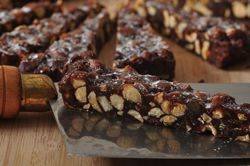
I always thought of Christmas fruit cake as a rich and heavy cake, full of candied fruit and nuts, that was soaked in alcohol and then frosted with royal icing and marzipan. It was the fruit cake of my youth, and it wasn't until years later that I realized there are other types of Christmas cakes.  Take for example, Panforte (pronounced pan-FOHR-tay), which comes from Siena Italy and also goes by the name Siena Cake. Although it does have some similarities to the 'British' fruit cake (containing the traditional fruit, nuts, and spices) its texture and flavor are very different. Bite into a slice of Panforte and you may be surprised to find how chewy it is. This chewy texture comes from mixing the fruit, nuts, spices, and flour (just enough to bind the ingredients), with a boiled syrup made from sugar and honey. This sugar/honey syrup, along with the addition of melted chocolate and cocoa powder, gives this Christmas cake an almost candy-like texture and flavor which is hard to resist, even for those who hate fruit cake.

Traditionally Panforte is baked in a round pan that has been lined with communion wafers (to make it easier to remove) which seems to indicate a religious connection. History does tell us that Panforte dates from the 12th century and, although stories differ, most agree that Nuns (hence the use of communion wafers) were the first to make this delicious bread. Now, for most of us communion wafers can be difficult to find so luckily Jane Grigson in 'The Best of Jane Grigson - The Enjoyment of Food' offers us a great substitute; edible rice paper. which is available at most Asian markets. Another distinctive characteristic of this cake is the dusting of the top of the cake with confectioners' (powdered/icing) sugar. This gives it a very festive 'snowy' look which adds to the holiday mood.  Although this cake was once made only during the Christmas season, its popularity has now made it a year round favorite. 

As far as making this recipe, its fairly easy, the only difficult part is the making of the sugar syrup which a good candy thermometer will take care of. Once the honey and sugar are boiled to the soft ball stage (240 degrees F) (115 degrees C) it is poured over the rest of the ingredients. At this point you will need to work quickly before the mixture stiffens and becomes difficult to spread in the pan.  Traditionally this cake was made with almonds but hazelnuts as well as macadamia nuts are excellent in this cake. And although I have used candied lemon and orange peel again you can vary this recipe by using other candied fruits or even dried fruits (cranberries, cherries, apricots to name a few) especially if you want to make this cake off season when candied fruits are difficult to find.  Another thing with Panforte is that some like it very spicy so if you prefer it that way, go ahead and add some white or black pepper (1/2 to 1 teaspoon).  Incidentally, cocoa and chocolate were not found in the Panforte made by the Nuns. It wasn't until the 1800s that these ingredients made their way into the recipe and today you can find Panforte both with and without chocolate. 

As a final note, Panforte is like other fruit cakes in that it stores well. So you can squirrel it away in the cupboard and cut off a sliver any time of the year that your sweet tooth beckons.


Panforte: Butter and line with parchment paper an 8-inch (20 cm) tart pan.  Alternatively, and for a more authentic look, line the pan with edible rice paper (available at Asian markets).

First melt the chocolate in a stainless steel bowl over simmering water. Set aside. Then in a large bowl combine the nuts, candied fruit,  spices, flour, and cocoa powder.

Place the sugar and honey in a saucepan and,  over medium heat, bring to a boil. Using a candy thermometer, heat the mixture to the soft ball stage (240 degrees F) (115 degrees C).

Remove from heat and stir the sugar/honey syrup and the melted chocolate into the chopped nut and fruit mixture. The mixture will stiffen quickly so once combined, transfer to the prepared pan. With damp hands, or the back of a spoon or offset spatula, evenly spread the Panforte, smoothing the top.

Bake in a 300 degree F (150 degree C) oven for about 30-35 minutes or until the surface has fine blisters. Remove from oven and place on a wire rack. While the Panforte is still warm, remove the sides of the pan and heavily dust the top of the cake with confectioners' (powdered/icing) sugar. Gently rub the sugar into the cake.  (Note:  if you have lined the pan with rice paper you may find it has torn. If that is the case simply add more rice paper, using a little egg white as glue.) 

Once the cake has completely cooled, wrap tightly in plastic wrap and store in a cool, dry place. Well wrapped this cake will keep several months.

Serve this cake in thin slices as it is quite rich. 

Makes 1 - 8 inch (20 cm) cake. 

Note:  To remove the skins of the hazelnuts as well as to toast them:  bake in a 350 degree F (180 degree C) oven for 15 minutes or until fragrant and the skins begin to flake.  Remove from oven and place the hot nuts in a dish towel.  Roll up the towel and let the nuts sit (steam) for a few minutes then briskly rub the nuts in the towel to remove the skins.  Let cool before using.  Toasting the nuts not only removes the bitter skins but also enhances the sweet, rich, buttery flavor of the nut. 

To toast the almonds: bake in a 350 degree F (180 degree C) oven for about 5-10 minutes or until lightly browned.  Watch carefully as they can burn easily.  Remove from oven and let cool before using.

Panforte:

3 ounces (90 grams) semi-sweet chocolate, chopped

1 cup (125 grams) toasted and coarsely chopped hazelnuts

1 cup (120 grams) toasted and coarsely chopped blanched almonds

1 cup candied citrus (170 grams) (citron, lemon and/or orange peel)

1 teaspoon ground cinnamon

1/4 teaspoon allspice

1/2 cup (70 grams) all purpose flour

1 tablespoon Dutch-processed cocoa powder

2/3 cup (130 grams) granulated white sugar

2/3 cup (160 ml) honey

s


Save This Page to del.icio.us


A baking resource on the Internet since 1997

Contact Us   Privacy Policy

All content on this site is either original or has been significantly modified and changed from its credited original source.  Use of materials on Joyofbaking.com is entirely at the risk of the user and Joyofbaking.com or Stephanie Jaworski will not be responsible for any damages directly or indirectly resulting from the use.

This website and the contents thereof are not endorsed or sponsored by the owner of the "Joy of Cooking" series of books or its publisher Simon & Schuster, Inc.

Content in any form may not be copied or used without written permission of Stephanie Jaworski, Joyofbaking.com.  Students and non profit educators may use content without permission with proper credit. 

Copyright  1997 to 2008 Stephanie Jaworski