|
Strawberries are one of the first fruits of the season and have long been
associated with rebirth and Spring. In ancient times they were used
not only for food but also for medicinal purposes. Tamra Andrews in 'Nectar
and Ambrosia' tells how ancient hunters in Central Europe would eat
strawberries "to sharpen their powers of perception. Others used them to
cure nervous disorders, control heart palpitations, and purify the blood." Although we no longer use strawberries as a cure for our ailments, they are
nonetheless rich in Vitamin B and C and contain potassium, iron and fiber.
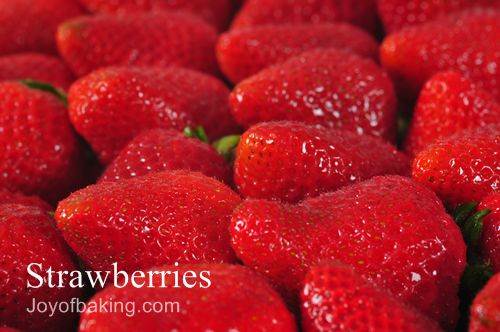
Strawberries are an aromatic, glistening-red,
roughly conically shaped berry covered with what looks like tiny black dots.
These dots are called achenes and are the true fruits of the strawberry plant. Each achene is really an individual fruit containing a single seed. This is why
the strawberry is a 'false' or 'accessory' fruit because it comes from the base
of the flower rather than the ovary.
Strawberries
are divided into two categories: Cultivated
and Wild. There are hundreds of varieties of cultivated strawberries. The modern hybrids were developed to make the strawberry more commercially
viable i.e. improving size, appearance and shipping quality, extending
the growing season, and overcoming diseases. There are spring
bearing and ever bearing varieties so strawberries are now available year round. The best tasting cultivated berries, however, are in the spring and summer
months. The small, sweet, deep-red wild strawberry (fraise des bois) is
difficult to pick, fragile and has a low yield so they are not cultivated
commercially. This makes them expensive, but try them if available as
their flavor is far superior to the cultivated strawberries. Adding a small
amount to a bowl of cultivated strawberries really improves the flavor of the
cultivated berries.
When choosing strawberries look for fragrant,
plump, firm, uniformly sized, bright-red berries with no white or green
"shoulders" at the stem end. The green leaf-like cap or hull should still be
attached and not brown or wilted. There should be no soft spots, bruising or
mildew. Always check the underside of the container to make sure there are no
squashed berries or red juice (sign of overripe berries). Strawberries range in
size and can be as small as a grape to as large as a golf ball. Size is not the
deciding factor to taste but generally the larger berries are not as flavorful.
Even though strawberries are usually picked before they are fully ripe they do
not ripen further after picking. They only get softer.
Strawberries are a delicate fruit and do not
store well. If not using immediately store in a single layer on a paper
towel-lined tray in the refrigerator up to 2-3 days. Do not wash or remove caps
before storing as strawberries absorb moisture. Immediately before using
quickly wash berries (do not soak), with caps still intact, so the berries will
not fill with water which, dilutes the flavor of the strawberry. Remove the
leaf-like caps with a sharp knife or strawberry huller.
Strawberry
Recipes
|
|
"Doubtless God could have made a
better berry, but doubtless God never did."
- by William
Butler (circa 1655)
YIELD:
1 dry pint = 2
cups sliced
FACTS:
- Strawberries
contain 85-90 percent water.
- The name
'Strawberry' comes from the 'straying' habit of the strawberry plant.
- 'Fraise des
bois' means strawberries of the woods,
- Wild
strawberries are very expensive, as they are difficult to pick, fragile,
and have a low yield.
- Wild
strawberries have a superior flavor to cultivated strawberries.
- Aroma, rather
than color or size, is the best indication of flavor.
- To bring out
the full flavor of strawberries, place hulled and sliced berries in a
bowl and sprinkle with granulated white sugar (about 2 tablespoons (28
grams) per pint). Let the berries and sugar macerate at room
temperature for at least 30 minutes.
-
The
strawberry plant is a member of the Rose family and the strawberry is
from the genus Fragaria, which is the symbol of the Virgin Mary and of
Summer.
EQUIPMENT:
Strawberry Huller - An
inexpensive stainless steel 2 1/2 inch long (6 cm) tweezers with wide
rounded concave ends that when placed on either side of the green
leaf-like stem, removes the stem plus the white core. Better than
a sharp knife as it does not cut into and remove any of the strawberry
flesh.
|