Baking Powder and Baking Soda
(Bicarbonate)
|
|
Both baking powder and
baking soda are chemical leavening agents that cause batters to rise when
baked. The leavener enlarges the bubbles which are already present in the
batter produced through creaming of ingredients. When a recipe contains baking
powder and baking soda, the baking powder does most of the leavening. The baking
soda is added to neutralize the acids in the recipe plus to add tenderness and
some leavening. When using baking powder or baking soda in a recipe, make sure
to sift or whisk with the other dry ingredients before adding to the batter to
ensure uniformity. Otherwise the baked good can have large holes.
Baking powder consists
of baking soda, one or more acid salts (cream of tartar and sodium aluminum
sulfate) plus cornstarch to absorb any moisture so a reaction does not take
place until a liquid is added to the batter. Most baking powder used today is
double-acting which means it reacts to liquid and heat and happens in two
stages. The first reaction takes place when you add the baking powder to the
batter and it is moistened. One of the acid salts reacts with the baking soda
and produces carbon dioxide gas. The second reaction takes place when the batter
is placed in the oven. The gas cells expand causing the batter to rise. Because
of the two stages, baking of the batter can be delayed for about 15-20 minutes
without it losing its leavening power.
Too much baking powder
can cause the batter to be bitter tasting. It can also cause the batter to rise
rapidly and then collapse. (i.e. The air bubbles in the batter grow too large
and break causing the batter to fall.) Cakes will have a coarse, fragile crumb
with a fallen center. Too little baking powder results in a tough cake that has
poor volume and a compact crumb.
Baking soda, also known
as sodium bicarbonate or bicarbonate of soda (alkali) is about four times as
strong as baking powder. It is used in recipes that contain an acidic
ingredient (e.g. vinegar, citrus juice, sour cream, yogurt, buttermilk,
chocolate, cocoa (not Dutch-processed), honey, molasses (also brown sugar),
fruits and maple syrup). Baking soda starts to react and release carbon dioxide
gas as soon as it is added to the batter and moistened. Make sure to bake the
batter immediately.
Baking soda has an
indefinite shelf life if stored in a sealed container in a cool dry place. Too
much baking soda will result in a soapy taste with a coarse, open crumb. Baking
soda causes reddening of cocoa powder when baked, hence the name Devil's Food
Cake.
|
|
Printer Friendly Page
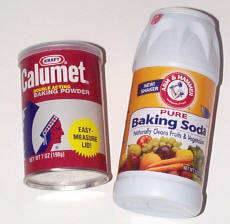
Products shown above
are for illustration purposes only and do not imply that they are
endorsed by joyofbaking.com.
Baking Soda
and Baking Powder
1 teaspoon = 5 grams
To test baking powder's effectiveness: mix 1 teaspoon (5 grams) baking
powder with 1/2 cup (120 ml) hot water and the mixture should bubble
immediately. Store in a cool dry place and it should be replaced every
6-12 months.
To
test
baking soda's effectiveness: mix 1/4 teaspoon baking soda with 2
teaspoons of vinegar and the mixture should bubble immediately.
Note:
The general rule of thumb for amount of
baking powder in recipes: 1 to 2 teaspoons (5-10 grams) of baking powder
leavens 1 cup (140 grams) of flour. The amount will
depend on the ingredients and how they are mixed.
Substitution for
1 teaspoon
commercial baking powder: 1/4 teaspoon (1.25 grams) baking soda, 1/2
teaspoon cream of tartar plus
1/4 teaspoon of cornstarch
or 1/4 teaspoon (1.25 grams)
baking soda plus 1/2 cup (120 ml) of an acidic ingredient (buttermilk,
sour milk or yogurt).
Since homemade baking powder
immediately releases its carbon dioxide gas when it is added and then
moistened by the batter, it is important to bake the batter right away.
Note: Cream of Tartar - Lining the inside of wine caskets after
fermentation is a white sediment (tartaric acid). This sediment is
removed, purified and then ground to produce a fine white powder which
we call cream of tartar. Cream of tartar can be found in the spice
section of most grocery stores and should be stored in a cool dry place.
|