Page loading ... Please wait.
 
Baking & Dessert Recipes & Photos
 
Web Joyofbaking.com


About Us

Substitutions

Ingredients

Glossary

Conversions


Home

Recipe Index

New Recipes

Breakfast & Brunch

Bars & Squares

Cakes

Cookies

Pies & Tarts

Pumpkin Recipes

Thanksgiving Baking

Apple Recipes

Comfort Foods

Biscotti

Quick Breads

Muffins

Scones

Shortbreads

Christmas Baking

Christmas Candy

Christmas Cookies

English Tea Party

Trifles

Blueberry Recipes

Lemon Recipes

Strawberry Recipes

Valentine's Day Desserts

Easter Baking

Ice Creams & Ices

Baking History

Bibliography

Pistachios

Pistachios are grown in climates that have hot dry summers and cold winters.  Turkey, Iran, Afghanistan, Italy and the United States (California) now cultivate pistachios.  The Middle Eastern nuts are more expensive but have more sweetness and depth of flavor. 

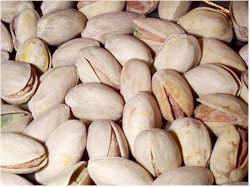
The tan shell of the pistachio nut is almost impenetrable before the nut matures.  Once it ripens though, the shell cracks open to reveal a delicate, sweet flavored, soft- textured, pale green and purple nut with a papery reddish-brown skin.

The pistachio nut used to be dyed a glaring pink-red so the nut would stand out (do not use this type in baking).  Today they are still sold this way but can also be found in their natural state.  Available year round shelled and unshelled, raw or roasted, salted or unsalted. 

Pistachios are used in both sweet (cookies, breads, ice creams and as a garnish) and savory dishes (particularly Middle Eastern, Mediterranean and Indian cuisines).

As with other nuts they should be stored in the refrigerator or freezer (about 6 months) in airtight containers or plastic bags. 

Pistachios are rich in calcium, thiamine, phosphorus, iron and vitamin A.

Printer Friendly Page

Pistachio Nuts

1 cup whole = 150 grams

s


Save This Page to del.icio.us


A baking resource on the Internet since 1997

Contact Us   Privacy Policy

All content on this site is either original or has been significantly modified and changed from its credited original source.  Use of materials on Joyofbaking.com is entirely at the risk of the user and Joyofbaking.com or Stephanie Jaworski will not be responsible for any damages directly or indirectly resulting from the use.

This website and the contents thereof are not endorsed or sponsored by the owner of the "Joy of Cooking" series of books or its publisher Simon & Schuster, Inc.

Content in any form may not be copied or used without written permission of Stephanie Jaworski, Joyofbaking.com.  Students and non profit educators may use content without permission with proper credit. 

Copyright  1997 to 2008 Stephanie Jaworski