|
Pie Crust: In
your food processor, place the flour, salt, and sugar and process
until combined. Add the butter and process until the mixture resembles coarse
meal (about 10 seconds). Sprinkle about
3 tablespoons of water over the flour mixture and process just
until the dough holds together when pinched. (You don't want a solid ball of
dough.) If necessary, add more water.
Turn your dough onto your work surface,
gather it into a ball, and flatten
into a round. Cover with plastic wrap and refrigerate for about one
hour or until firm. This will chill the butter and relax the gluten in the flour.
After the dough has chilled sufficiently,
remove from the fridge and
place on a lightly floured surface.
Roll the pastry into a
12 inch (30 cm) circle. (To prevent the
pastry from sticking to the counter and to ensure uniform thickness, keep
lifting up and turning the pastry a quarter turn as you roll (always roll from
the center of the pastry outwards).) Loosely roll the pastry
around your rolling pin and transfer to a 9 inch (23
cm) pie pan. Tuck the
overhanging pastry under itself and use a fork, or your fingers, to make a decorative
border. Cover
with plastic wrap and place in the refrigerator to chill.
Alternatively, you can trim the pastry to the edge of the pie
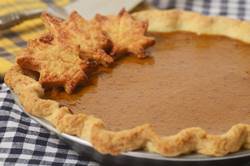
pan. With the remaining pastry you can make decorative cut-outs (leaves,
pumpkins, etc.). Bake in 375 degree F (190 degree C) oven until golden
brown (about 10 minutes). Use to decorate the baked pumpkin pie.
Pecan
Ginger Layer: Toast the pecans in a 350 degree F (180 degree
C) oven for about 8 minutes or until lightly browned and fragrant.
Cool and then place the pecans, along with the ginger cookies, in a
food processor and process until finely ground. Press this mixture
evenly onto the bottom of the unbaked pie crust. Cover and return the
pastry to the refrigerator while you preheat the oven.
Increase the oven temperature
to 375 degrees F (190 degrees C) and place the
oven rack in the lower
third of the oven. Place a baking sheet on the rack while preheating
the oven.
Pumpkin
Filling:
In a large bowl lightly whisk the eggs. Add the remaining ingredients
and stir to combine.
Pour the mixture into the prepared pie shell.
Set the pie on the baking sheet and bake for about
40 - 50 minutes or until the
crust has browned and the filling is set around the edges but the
center of the pie will still look wet. (A knife inserted into the filling about 1 inch (2.5 cm) from
the side of the pan will come out almost clean.)
Place the baked pie on a wire rack to cool. Serve at room temperature with whipped cream. Store any
leftovers in the refrigerator.
Makes one 9 inch (23 cm) pie.
Whipped Cream:
In the bowl of your
electric stand mixer, fitted with the whisk attachment (or with a hand
mixer or wire whisk), whip the cream with the sugar until soft
peaks form.
View comments on this recipe on YouTube |
|
Pie Crust:
1 1/3 cups (175 grams) all-purpose
flour
1/2 teaspoon
(2 grams) salt
1 tablespoon (15 grams) granulated
white sugar
1/2 cup (113 grams)
cold unsalted butter, cut into 1 inch (2.5 cm) chunks
3
to 4 tablespoons
icy cold water
Pecan and Ginger Layer:
(optional)
1/4
cup (25 grams) pecans
2 tablespoons
(15 grams) crushed ginger cookies (homemade or store bought)
Pumpkin Filling:
3
large (150 grams) eggs, at room temperature
1 - 15 ounce can (425 grams) pure pumpkin
puree (no spices added)
1/2
cup (120 ml/grams) heavy whipping cream, at room
temperature (cream with a 36-40% butterfat content)
1/2
cup (100 grams) light brown sugar, firmly
packed
1
teaspoon ground cinnamon
1/2
teaspoon ground ginger
1/8
teaspoon ground cloves
1/8 teaspoon freshly
grated nutmeg
1/2
teaspoon (2 grams) salt
Whipped Cream:
1
cup (240 ml/grams) cold heavy whipping cream (cream with a 36-40% butterfat
content)
1 - 2 tablespoons (15
- 25 grams) granulated white sugar or pure maple syrup, or to taste |