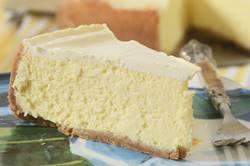
New York Cheesecakes are creamy, and smooth, and rich, and dense, and absolutely
delicious. This cheesecake has three layers, starting with a graham cracker crumb crust
that is topped with a cream cheese filling, and then a layer of lightly
sweetened sour cream.
There are two popular cheesecakes in America today, the ones
made with cream cheese (shown here) and the ones made with ricotta. John Mariani tells
us in his The Dictionary of American Food & Drink that Americans have come to know
cheesecakes made with cream cheese as 'New York' or 'Jewish' Cheesecakes, and ones
made with ricotta as 'Italian' Cheesecakes, with both types having
their roots in immigrant New York City neighborhoods.
We start this
recipe by making the
Graham Cracker crust which is, by far, the simplest of all the pie
crusts. Now, if you have problems with getting the right crust
consistency, the test to see if you have the right amount of crumbs to
melted butter is, once you have mixed the ingredients together, to squeeze
some in your fist. If the crumbs hold together, you have the perfect
crust. Once the crust is made and pressed into the tart pan, it is left to
chill in the refrigerator. If you would prefer a firmer crust, instead of
chilling you can bake the crust in a 350 degrees F (177 degree C) oven for
about 10 minutes. The next step is to simply mix the filling ingredients
together. Make sure to use full fat cream
cheese and have it, as well as the eggs and cream, at room temperature. We cannot talk about
cheesecakes without mentioning the pitfalls, mainly the questions of how do
we prevent cracking and when are cheesecakes done? First, let's talk
about cracks on the surface of a baked cheesecake, as this is a common
problem and is caused either by over beating the batter and/or by too much
moisture being lost as the cheesecake bakes (over baking). In order
to prevent cracks make sure you beat the ingredients at low speed as,
unlike a butter cake, you do not want to incorporate a lot of air into the batter,
you only want to beat the ingredients until they are nice and smooth. As far as the over baking of cheesecakes goes, this is a common problem as
it is difficult to know when a cheesecake is done. The thing to
remember is that you want the cheesecake to be firm but, if you shake the
pan gently, it should still wobble a little, and the center will still
look a little wet. For even though the center may not look fully
baked, once it cools it will firm up and be the correct consistency. Cheesecakes are cakes that should not to be eaten straight away as they
need to cool and then be refrigerated for several hours, preferably
overnight, so the flavors have time to blend and the texture becomes nice
and firm. The great thing about cheesecake is that it stores very
well and can also be frozen. To freeze, place the cooled cheesecake on a baking pan and freeze, uncovered, until firm. Remove the cheesecake from the freezer, wrap it in heavy duty aluminum foil and
place in a freezer bag. Seal and return to freezer. It can be frozen
for several months. Thaw the uncovered cheesecake in the refrigerator
overnight.
New York Cheesecake: Grease, or spray with Pam,
a 9 inch (23 cm) springform pan. Place the springform pan on a larger
baking pan to catch any leakage while the cheesecake is baking. Preheat oven to 350
degrees F (177 degrees C) with rack in center of oven.
For Crust: In a medium sized bowl
combine the graham cracker crumbs, sugar, and melted butter. Press the crumbs evenly over the bottom and about 1 inch (2.5 cm) up the sides of the springform pan. Cover and refrigerate while you make the filling.
For Filling: In bowl of your electric
mixer place the cream cheese, sugar, and flour. Beat on medium speed until
smooth (about 2 minutes), scraping down the bowl as needed. Add the eggs,
one at a time, beating well (about 30 seconds) after each addition. Scrape down the sides of the bowl. Add the whipping cream, lemon
zest, vanilla extract and beat until incorporated. Remove the crust from
the refrigerator and pour in the filling. Place the cheesecake pan on a
larger baking pan and place in the oven.
Bake for 15
minutes and then lower the oven temperature to 250 degrees F (120 degrees C) and
continue to bake for about another 60 - 90 minutesor until firm and only the center of the cheesecake looks a little wet and
wobbly. (The baking time can vary due to the differences in ovens, so make
sure to check that the cheesecake is firm with only the center being a little
wet and wobbly.)
Remove from oven and place on a wire rack.
Meanwhile, in a small bowl
combine the sour cream, sugar, and vanilla extract. Spread the topping
over the warm cheesecake and return to oven to bake for 15 more minutes.
Remove from oven and carefully run a knife or spatula around the inside edge of
pan to loosen the cheesecake (helps prevent the surface from cracking as it
cools).
Let cool completely before covering
with plastic wrap. Refrigerate several hours, preferably overnight. Serve with
fresh fruit or fruit sauces.
Makes one - 9 inch (23 cm)
cheesecake.
To freeze: Place the
cooled cheesecake on a baking pan and freeze, uncovered, until firm. Then wrap in aluminum foil and
place in a freezer bag. Seal and return to freezer. Can be frozen
for several months. Thaw uncovered cheesecake in the refrigerator
overnight.
Tips:
Sometimes the surface of the cheesecake cracks. To help prevent
this from happening do not over beat the batter, especially when
creaming
the cheese and sugar.
Another reason for
cracking is overbaking the cheesecake. Your cheesecake is done
when it is firm but the middle may still look a little wet.
Also, make sure the
springform pan is well greased as cracking can occur if the cheesecake
sticks to the sides as it cools.
References
cited may include a link to purchase the referenced book on Amazon.com.
Joyofbaking.com receives a commission on any purchases resulting from these
links.
This
website and the contents are not endorsed or sponsored by the owner of the
"Joy of Cooking" series of books or its publisher Simon & Schuster, Inc.
Video icons by Asher.
Content in any form may
not be copied or used without written permission of Stephanie Jaworski,
Joyofbaking.com. Students and non profit educators may use content without
permission with proper credit.