Page loading ... Please wait.
 
Baking & Dessert Recipes & Photos
 
Web Joyofbaking.com


About Us

Substitutions

Ingredients

Glossary

Conversions


Home

Recipe Index

New Recipes

Breakfast & Brunch

Bars & Squares

Cakes

Cookies

Comfort Foods

Pies & Tarts

Biscotti

Quick Breads

Muffins

Scones

Shortbreads

English Tea Party

Trifles

Apple Recipes

Lemon Recipes

Strawberry Recipes

Christmas Baking

Christmas Candy

Christmas Cookies

Valentine's Day Desserts

Thanksgiving Baking

Easter Baking

Ice Creams & Ices

Baking History

Bibliography

Gingerbread Scones Recipe

Printer Friendly Page

Gingerbread Scones Recipe

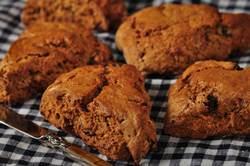
Gingerbread scones are delicious.  They have a wonderful earthy brown color and their flavor is dark and rich which comes from adding molasses and ground spices (cinnamon, ginger, and cloves) to a basic scone dough.  I have also added some rolled oats to give the scones a more hearty taste and dried cranberries also provide a nice jolt of flavor.  Now, there are two types of molasses generally used in making gingerbread: light and dark.  Light molasses, used in this recipe, comes from the first boiling of the sugar syrup and is lighter in flavor and color than the dark molasses.  Dark molasses comes from the second boiling and is darker in color with a more robust flavor. 

Molasses is usually labeled as "sulphured" or "unsulphured" depending on whether sulphur was used in the processing.  The unsulphured molasses is lighter in color and tends to have a nicer flavor. Molasses is used to add color, moistness and flavor to the scones.  For the liquid part of the scone dough we are going to use buttermilk, which gives us a lighter, more bread-like scone.  Buttermilk has a nice thick creamy texture with a rich tangy buttery taste that makes baked goods tender. In the past buttermilk was made from the liquid left over after churning butter, but it is now commercially made by adding a bacteria to whole, skim, or low fat milk.  You can make your own buttermilk by adding 1 tablespoon of white distilled vinegar, cider vinegar, or lemon juice to 1 cup of milk.  Let stand 5 to 10 minutes before using.  I have also provided a recipe for an optional maple glaze that can be drizzled over the baked scones.  This adds wonderful flavor to the gingerbread scones.

Oats are a cereal grain that is rich and flavorful and comes in many forms.  They are very popular in Northern Europe, Scotland and Ireland.  Oats are first cleaned, toasted, hulled to become what we call oat groats.  The oat groats are then steamed and flattened to become rolled oats or old-fashioned oats.  They take about 15 minutes to cook.  Old-fashioned rolled oats are not to be confused with quick-cooking rolled oats.  These are oats have been cut into pieces before being steamed and rolled into thinner flakes.  They cook quickly, about 5 minutes, but their flavor and texture are a little different than old-fashioned rolled oats.


Preheat oven to 400 degrees F (200 degrees C) and place rack in middle of oven.  Line a baking sheet with parchment paper. 

In a large bowl, whisk together the flour, oats, sugar, spices, baking powder, baking soda and salt.  Cut the butter into small pieces and blend into the flour mixture with a pastry blender or two knives. The mixture should look like coarse crumbs.  Stir in the lemon zest and dried cranberries, if using.  In a separate bowl mix together the buttermilk, molasses and vanilla and then add the buttermilk mixture to the flour mixture.  Mix just until the dough comes together. Do not overmix the dough.

Transfer to a lightly floured surface and knead dough gently four or five times and then pat the dough into a circle that is about 7 inches (18 cm) round and about 11/2 inches (3.75 cm) thick. Cut this circle in half, then cut each half into 3 pie-shaped wedges (triangles).  Place the scones on the baking sheet.  Make an egg wash of one well-beaten egg mixed with 1 tablespoon milk and brush the tops of the scones with this mixture.  Sprinkle the tops of the scones with some rolled oats.

Place the baking sheet inside another baking sheet to prevent the bottoms of the scones from over browning.  Bake for about 20 minutes or until golden brown and a toothpick inserted in the middle comes out clean.   Transfer to a wire rack to cool.  

To Glaze:  Mix together the glaze ingredients, adding more sugar or milk until you get the desired consistency.  It needs to be thin enough that it can be drizzled over the tops of the cooled scones.  With a spoon drizzle the glaze over the tops of the scones and let dry. 

Makes 6 scones.


Scone Dough:

1 3/4 cups (245 grams) all purpose flour

3/4 cup (60 grams) old fashioned rolled oats

1/3 cup (72 grams) light brown sugar

2 teaspoons ground ginger

1 1/2 teaspoons ground cinnamon

1/8 teaspoon ground cloves

1/4 teaspoon salt

2 teaspoons baking powder

1/2 teaspoon baking soda

1/2 cup (113 grams) cold unsalted butter, cut into pieces

Zest of 1 lemon (optional)

1/3 cup (35 grams) dried cranberries or cherries (optional)

1/2 cup (120 ml) buttermilk

2 1/2 tablespoons unsulphured molasses

1 teaspoon pure vanilla extract

Egg Wash:

1 large egg

1 tablespoon milk or cream

Maple Glaze: (optional)

1/2 cup (50 grams) sifted confectioners (powdered or icing) sugar

1 1/2 tablespoons pure maple syrup

1 - 2 teaspoons cream or milk

Lemon Zest - The yellow outer rind of the lemon that contains the fruit's flavor and perfume.  The rind being the outer skin of the lemon which consists of both the yellow zest and white membrane (pith).

s


Save This Page to del.icio.us


A baking resource on the Internet since 1997

Contact Us   Privacy Policy

All content on this site is either original or has been significantly modified and changed from its credited original source.  Use of materials on Joyofbaking.com is entirely at the risk of the user and Joyofbaking.com or Stephanie Jaworski will not be responsible for any damages directly or indirectly resulting from the use.

This website and the contents thereof are not endorsed or sponsored by the owner of the "Joy of Cooking" series of books or its publisher Simon & Schuster, Inc.

Content in any form may not be copied or used without written permission of Stephanie Jaworski, Joyofbaking.com.  Students and non profit educators may use content without permission with proper credit. 

Copyright  1997 to 2008 Stephanie Jaworski