Pavlova (Pav) is a Meringue Cake
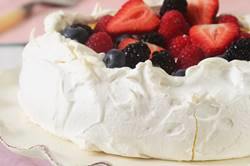
that has a light and delicately crisp crust with a soft marshmallow center. This dessert is typically served with
whipped cream and fresh fruit. There is a long standing debate about whether New Zealand
or Australia invented this dessert. What we do
know is that the name, Pavlova, was chosen in honor of the Russian ballerina,
Anna Pavlova, who toured both New Zealand and Australia in 1926.
A few notes on
making a Pavlova. First, a Pavlova is a meringue, and it is important when making any meringue that the egg whites reach maximum volume,
so make sure your mixing bowl and whisk
are clean and free of grease. Since we need just the whites of the eggs,
the eggs will need to be separated. It is easier to do this while the eggs
are still cold. Once separated, cover the egg whites and let them come to room
temperature before using (about 30 to 60 minutes). I like to use superfine sugar (castor) when making this
meringue as it
dissolves faster into the egg whites than granulated white sugar. You
can make your own superfine sugar by processing 1 cup (200 grams) granulated white sugar in your food processor until very fine, about 30
- 60 seconds.
To make a Pavlova, first beat the egg whites and
cream of tartar until soft peaks form.
Cream of tartar (or an equal amount of lemon juice) is added to stabilize
the egg whites and prevent over beating. Then add the sugar, one tablespoon at a time, and continue to beat until
the meringue forms stiff and shiny peaks. Beat in the vanilla extract and
then gently fold in the cornstarch and vinegar. (Adding these two ingredients
will give the Pavlova a crust that is dry and crisp, with a soft
marshmallow-like interior.)
Australian Stephanie Alexander in her
excellent book "The Cook's Companion" gives us a few pointers on how to
tell a good Pavlova, "if syrupy droplets form on the surface of the
meringue, you'll know you have overcooked it; liquid oozing from the
meringue is a sign of undercooking". So it is best to cook the meringue in
a slow oven and then to turn off the oven and let it cool slowly. This
will take several hours.
The Pavlova can be made a day or two in advance of serving, if it is
stored in a cool dry place, in an airtight container. A Pavlova is
usually served with softly whipped cream and fresh fruit. Because of the
sweetness of the meringue I like to offset the sweetness with tart
flavored fruits. Passion fruit, kiwi, blackberries, blueberries, and
raspberries are some of my personal favorites. Try to place the
whipped cream and fruit on the meringue shortly before serving as the
meringue will immediately start to soften and break down from the moisture
of the whipped cream and fruit.
Pavlova: Preheat
your oven to 250 degrees F (130 degrees C) and place rack in center of oven. Line
a baking sheet with parchment paper and draw a 7 or 8 inch (18 - 20 cm) circle on the
paper. Turn the parchment paper over so the circle is on the reverse side.
In the bowl
of your electric stand mixer, fitted with the whisk attachment (or with a hand
mixer), beat the egg whites and cream of tartar on
medium low speed until they hold soft peaks. Start adding the sugar, a
tablespoon at a
time, and continue to beat, on high speed, until the meringue holds very stiff
and shiny peaks. (Test
to see if the sugar is fully dissolved by rubbing a little of the meringue between
your thumb and index finger. The meringue should feel smooth, not gritty. If it feels gritty
the sugar has not fully dissolved so keep beating until it feels smooth between
your fingers). Beat in the vanilla extract. Sprinkle the vinegar and cornstarch over the top of the
meringue and, with a rubber spatula, gently fold in. Spread the meringue inside the circle drawn on the parchment paper, smoothing the
edges.
Bake for about 60
minutes or until the outside is dry and
is a very pale cream color. Turn the oven off, leave the oven door slightly
ajar, and let the meringue cool completely in the oven. (The outside of the
meringue will feel firm to the touch, if gently pressed, but as it cools you
will get a little cracking and you will see that the inside is soft like
marshmallow.)
The cooled
meringue can be made and stored in a cool dry place, in an airtight container, for a few days.
Just before
serving gently place the meringue onto a serving plate.
Topping: Whip the cream,
sugar, and vanilla extract in
your electric stand mixer, fitted with the whisk attachment (or with a hand
mixer or wire whisk), until still peaks form. Mound the whipped cream into
the center of the meringue. Arrange the fruit randomly, or in a decorative
pattern, on top of the cream. Serve immediately as this dessert does
not hold for more than a few hours.
Use of materials on
all pages on the domains Joyofbaking.com,
the Joyofbaking.com Facebook
Page, the
Joyofbaking1 YouTube
Channel and any emails sent from @joyofbaking.com
are
entirely at the risk of the user and their owner, iFood Media LLC
will not be responsible for any damages directly or indirectly resulting
from the use.
References
cited may include a link to purchase the referenced book or item on Amazon.com.
Joyofbaking.com receives a commission on any purchases resulting from these
links.
This
website and the contents are not endorsed or sponsored by the owner of the
"Joy of Cooking" series of books or its publisher Simon & Schuster, Inc.
and is not related to the "Joy the Baker" books and website.
Video icons by Asher.
Content in any form may
not be copied or used without written permission of Stephanie Jaworski,
Joyofbaking.com. Students and non profit educators may use content without
permission with proper credit.