Page loading ... Please wait.
 
Baking & Dessert Recipes & Photos
 
Web Joyofbaking.com


About Us

Substitutions

Ingredients

Glossary

Conversions


Home

Recipe Index

New Recipes

Breakfast & Brunch

Bars & Squares

Cakes

Cookies

Pies & Tarts

Pumpkin Recipes

Thanksgiving Baking

Apple Recipes

Comfort Foods

Biscotti

Quick Breads

Muffins

Scones

Shortbreads

Christmas Baking

Christmas Candy

Christmas Cookies

English Tea Party

Trifles

Blueberry Recipes

Lemon Recipes

Strawberry Recipes

Valentine's Day Desserts

Easter Baking

Ice Creams & Ices

Baking History

Bibliography

Ricotta Cheesecake Recipe

Printer Friendly Page

Ricotta Cheesecake

History tells us that cheesecakes have been around since the 15th century and were originally defined as a "cooked tart made from curd cheese, with the addition of ingredients such as eggs, sugar, and spices." (John Ayto 'An A-Z of Food & Drink). Today cheesecakes still contain eggs and sugar but, at least in North America, we prefer replacing the curd cheese with either ricotta and/or cream cheese. 

For this recipe I have combined the best of both worlds, ricotta and cream cheese, to produce a cheesecake that is both light and fluffy (from the ricotta) and wonderfully creamy (from the cream cheese). Ricotta (means "recooked") is a cheese made from the whey (watery residue from making other cheeses) that is cooked to produce a mild tasting, soft, yet granular white cheese. It is very similar to our cottage cheese. I like to use whole milk ricotta in this recipe and you will need to drain it before adding it to the cheesecake batter. Do this by either placing the ricotta in a fine-meshed strainer or else a cheesecloth-lined strainer that has been suspended over a bowl. Cover and place in the refrigerator to drain for several hours, or even overnight.

The most important thing to remember when making a cheesecake is to have all the ingredients at room temperature. Beat the cream cheese just until it is creamy and smooth (no lumps) and then add the ricotta and sugar. You can do this in either an electric mixer or food processor. Just make sure you scrape down the bowl often to remove any lumps and beat at low speed to reduce the amount of air incorporated into the batter. Too much air will cause the cheesecake to rise during baking only to disappointedly sink once it has been removed from the oven. Another thing to remember is that since cheesecakes are a custard it is best to bake them in a water bath. A great piece of advise was given by Rose Berenbaum in her book 'Cake Bible' where she says to add a little cornstarch to prevent leakage. Of course, there is always the question of when is a cheesecake done? For this recipe it is done when the cake has turned a light golden brown color and the filling has set but is still a little wobbly in the center. As with all cheesecakes, let it cool before covering and placing in the refrigerator. I find cheesecakes do benefit from sitting overnight in the fridge so the flavors have time to soften and blend. You can freeze this cheesecake for about a month by wrapping it in foil and placing it in a airtight bag. Defrost by placing the frozen cheesecake in the refrigerator overnight to thaw.

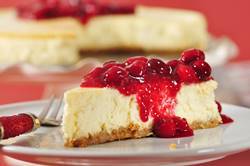
Although some like their cheesecake plain, I prefer serving it with either fresh fruit or a fruit sauce. While I am very fond of the raspberry or strawberry sauces on the site, for the Christmas season I like to serve this cake with a Cranberry Raspberry Sauce. This is done by cooking cranberries and raspberries with sugar, cornstarch (thickener), and a little lemon or orange zest. This sauce is also excellent over ice cream.


Preheat oven to 350 degrees F (180 degrees C) and butter, or spray with non stick cooking spray, a 9 inch (23 cm) spring form pan. Wrap the outside of the pan with two layers of heavy aluminum foil. 

For Crust: In a medium sized bowl combine the graham cracker crumbs, sugar, and melted butter. Press the crumbs evenly over the bottom of the spring form pan. Cover and refrigerate while you make the filling.

For Filling: Place the ricotta in a fine-meshed strainer or else a cheesecloth-lined strainer that has been suspended over a bowl. Cover and place in the refrigerator to drain for several hours, or even overnight.

In the bowl of your food processor or electric mixer (or with a hand mixer), place the cream cheese and beat until smooth and free of lumps. Add the ricotta and sugar and beat until smooth (about 2 - 3 minutes), scraping down the bowl as needed. Beat in the cornstarch. Add the eggs, one at a time, beating about 30 seconds after each addition. Scrape down the sides of the bowl. Beat in the lemon zest, vanilla extract, and salt and beat until incorporated. 

Remove the crust from the refrigerator and pour in the filling. Place the spring form pan in a large roasting pan. Pour enough hot water into the roasting pan to come about halfway up the sides of your spring form pan. 

Bake for about one hour to one hour 15 minutes, or until the top of the cheesecake has nicely browned and the center of the cake moves slightly when the pan is gently shaken. Remove the pan from the water bath and cool on a wire rack. Cover and refrigerate until the cheesecake is cold, about 6 - 8 hours or overnight. Serve in small slices with a spoonful of Cran-Raspberry Sauce (if desired).

Cran-Raspberry Sauce: In a large saucepan combine all the ingredients. Cook over medium heat, stirring often, until the sauce thickens and is bubbly. Remove from heat and let cool. (Note: taste and add more sugar as needed.) Cover and store in the refrigerator. Makes about 2 cups (480 ml).

Crust:

1 cup (100 grams) graham wafer or digestive biscuit crumbs

2 - 3 tablespoons (30 - 45 grams) granulated white sugar

1/4 cup (57 grams) unsalted butter, melted

Filling:

20 ounces (2 1/2 cups) (570 grams) fresh whole milk ricotta, drained

1 - 8 ounce (227 grams ) cream cheese, room temperature (use full fat, not reduced or fat free cream cheese)

1 cup (200 grams) granulated white sugar

1 tablespoons cornstarch (corn flour)

4 large eggs, room temperature

Zest of 1 lemon or orange

1 1/2 teaspoons pure vanilla extract

Cran-Raspberry Sauce:

3 cups (300 grams) frozen unsweetened raspberries

2 cups (200 grams) fresh cranberries

1/2 cup (100 grams) granulated white sugar (or more to taste)

1 tablespoon cornstarch (corn flour)

Zest of a lemon or orange (optional)

s


Save This Page to del.icio.us


A baking resource on the Internet since 1997

Contact Us   Privacy Policy

All content on this site is either original or has been significantly modified and changed from its credited original source.  Use of materials on Joyofbaking.com is entirely at the risk of the user and Joyofbaking.com or Stephanie Jaworski will not be responsible for any damages directly or indirectly resulting from the use.

This website and the contents thereof are not endorsed or sponsored by the owner of the "Joy of Cooking" series of books or its publisher Simon & Schuster, Inc.

Content in any form may not be copied or used without written permission of Stephanie Jaworski, Joyofbaking.com.  Students and non profit educators may use content without permission with proper credit. 

Copyright  1997 to 2008 Stephanie Jaworski