here
are many recipes for sponge cakes and choosing one can be difficult especially
as there are two types; the European sponge and the American sponge.
Both
types are similar in that they have that distinctive spongy texture and contain no solid fat (except the Genoise which contains melted butter).
But because sponge cakes contain no solid fat, Rose Levy Beranbaum tells us in her book "The Cake Bible" that there are two ways to achieve a moist textured cake. One way is to
moisten the cake after it is baked with a soaking syrup (European Sponge), and
the other way is to add extra sugar to the batter (American Sponge).
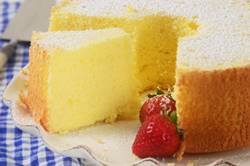
This is a recipe for an American sponge cake. It has a spongy texture yet
because of the extra sugar it is moist and tender. This makes it the
perfect cake to serve plain with a cup of tea yet it is also excellent
when served with fresh fruit and softly whipped cream. The one thing that
this batter does need to balance the extra sugar is lemon zest. Lemon zest
is the outer yellow skin of the lemon and contains the fruit's flavor and
perfume. Make sure when you remove the yellow peel (with a grater) you do
not have any of the white membrane (pith) as this is quite bitter tasting.
Sponge cake get
their rise, not from baking powder, but solely from the air whipped into the eggs.
The eggs need to be at room temperature and the egg yolks and sugar are beaten
until thick, light, and fluffy which can take as long as five minutes. This long beating
time is necessary for it not only gives the baked cake its full volume, it also
gives the cake its nice open grain. But care
must be taken when folding the beaten egg whites into the egg yolk mixture to ensure that
the batter does not deflate too much. A few quick strokes with a rubber spatula or
large balloon whisk are all that is needed.
This
recipe uses an ungreased tube pan with a removable bottom to give the cake
support as well as making it easier to remove. The pan is left ungreased so the batter can cling to the
sides of the pan as it bakes and allows the cake to reach its full volume. The hole in the middle of the pan allows the hot air to circulate and reach the
center of the cake. Once the cake is baked it is immediately inverted so the
baked cake will maintain its volume and keep it from shrinking as it cools. You
can serve this cake plain with just a dusting of powdered (confectioners of
icing) sugar or with fresh fruit and softly whipped cream.
Preheat
oven to 350 degrees F (177 degrees C) and place rack in center of oven. Have ready an ungreased two-piece 10 inch (25 cm) tube pan.
For Sponge Cake: Separate the
eggs while they are still cold, and cover the
whites and yolks with plastic wrap
to prevent a film from forming on the egg yolks and the whites from drying out. Let the yolks and whites reach
room temperature before using (this will take about 30 minutes). Having
the yolks and whites at room temperature will ensure that the eggs reach their
full volume when beaten.
Meanwhile
sift and measure the cake flour and then whisk the flour with 1/4 cup (50 grams)
of granulated white sugar. Measure another 1/4 cup (50 grams) of
granulated white sugar and set aside for beating with the egg whites.
Place the
final 1/2 cup (100 grams) of granulated white sugar in your electric mixer
fitted with the paddle attachment (or use a hand mixer). Add the egg yolks and beat
on high speed for about five minutes, or until they are thick, fluffy and light
colored (when you slowly raise the beaters the batter will fall back into the
bowl in a slow ribbon). At this point beat in the vanilla extract, water, and
lemon zest. Sift the flour/sugar mixture over the batter but do not fold
in. (You will fold the flour mixture into the batter along with the beaten
egg whites.)
In a clean bowl, with the whisk
attachment, whip the egg whites until foamy. Add the cream of tartar and
continue beating until soft peaks form. Gradually add the 1/4 cup (50
grams) of granulated white sugar and continue beating until the egg whites are shiny
and stiff peaks form. Gently fold a little of
the whites into the batter to lighten it, and then add the rest of the whites,
folding just until incorporated. Do not over mix or you will deflate the
batter. Pour the batter into the tube pan, evenly spreading the cake
batter with your spatula.
Bake in the preheated oven for 30 - 35 minutes or
until lightly browned and a toothpick inserted in the middle comes out clean. Remove from oven and immediately invert. If your tube pan does not have
feet then place on top of a bottle or bowl. Cool for at least one hour before unmolding. Run a
spatula or sharp knife around the inside of the pan and then remove the center
core of the pan. Then run the spatula or knife along the bottom and center
core of the pan. Invert the cake onto a greased wire rack.
At this point the cake can be served plain
with a dusting of confectioners (powdered or icing) sugar or with fresh fruit
and softly whipped cream.
For Whipped Cream: In a large mixing bowl place the whipping cream,
vanilla extract, and sugar and
stir to combine. Cover and chill the bowl and beaters in the refrigerator for at
least 30 minutes. When chilled, beat the mixture until stiff peaks form.
The cake can be stored in the refrigerator in
an airtight container for a few days. This cake is best the day it is
made.
Adapted from:
Beranbaum. Rose
Levy. "The Cake
Bible". William Morrow and Company, Inc. New York: 1988.
Stern, Bonnie.
"Cooking with Bonnie Stern". Random House of Canada. Toronto: 1986.
All content on this site is
either original or has been significantly modified and changed from its
credited original source. Use of materials on Joyofbaking.com is
entirely at the risk of the user and Joyofbaking.com or Stephanie Jaworski
will not be responsible for any damages directly or indirectly resulting
from the use.
This
website and the contents thereof are not endorsed or sponsored by the owner
of the "Joy of Cooking" series of books or its publisher Simon & Schuster,
Inc.
Content in any form may
not be copied or used without written permission of Stephanie Jaworski,
Joyofbaking.com. Students and non profit educators may use content without
permission with proper credit.