|
Strawberry Sauce: Place
the frozen strawberries in a large bowl
and thaw. Then place the strawberries and
their juices
in the bowl of your food processor or blender and process until they are pureed
(can also use an immersion blender). Add
the sugar and stir until the it dissolves. Taste and add more sugar if
needed. Cover and place in the refrigerator until well chilled (can be made up
to a week in advance). Makes about 1 1/2 cups (360 ml).
Sponge Cake:
Preheat oven to 350 degrees F (180 degrees C). Butter and flour an 8 inch (20 cm) cake pan.
Then line the bottom of the pan with
parchment paper.
In your electric mixer, or with a hand mixer, beat the eggs and sugar
on high speed for about five to ten minutes, or until thick, fluffy and light
colored (when you slowly raise the beaters the batter will fall back into the
bowl in a ribbon). Add the vanilla extract and beat until incorporated. In a small bowl whisk together the flour and salt. Sift
about 1/3 of the flour over the batter and gently fold through with a rubber spatula
or whisk. Add the remaining flour in two additions, sifting the flour over the batter and folding in. Whisk about 1/3 cup
(80 ml) of the batter into the melted butter (to lighten it) and
then gently fold the butter mixture back into the rest of the batter. Pour
immediately into the prepared pan and bake
for about 16-20
minutes or
until springy to the touch. (A toothpick inserted in the middle will come
out clean.) Remove from oven and place on a wire rack to cool for about 10
minutes. Run a
spatula or sharp knife around the inside of the pan and then invert the cake onto a wire rack. Remove parchment paper. Set aside. (The cake can be made a day
in advance.)
Strawberry
Cream. Chill your mixing bowl and whisk in the freezer for about 15
minutes. Meanwhile, in a small measuring cup, stir together the gelatin and
1/4 cup (60 ml) of the strawberry sauce. Let this mixture sit for 5 - 10 minutes
(or until spongy) and
then microwave for a few seconds to dissolve the gelatin. Once the gelatin
has dissolved, stir the gelatin mixture into the remaining 1/2 cup (120 ml) of
strawberry sauce. Set aside while you whip the cream.
Remove the mixing
bowl and whisk from the freezer, and beat the cream
and sugar until stiff peaks form. Add the strawberry sauce mixture and beat until
thoroughly mixed in. Taste and fold in a little more sugar, if needed.
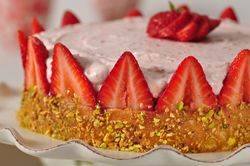
To assemble the Charlotte: Place the
cooled cake layer on the bottom of an 8 inch (20 cm) springform pan. Spread 1/4
cup (60 ml) of strawberry sauce over the top of the sponge cake. Halve the strawberries and
fit them, snugly,
on top of the cake with the cut sides facing the outside edge of the pan. Fill the
center of the cake with the the strawberry whipped cream. Smooth the top,
cover loosely with plastic wrap, and chill for about 3-4 hours (preferably
overnight) so the cream has time to set.
To unmold and serve:
Several hours before serving, gently remove the sides of the springform pan. Heat the apricot preserves in a small saucepan over low heat
(or in the microwave) until warm and then strain. Then, using a pastry brush,
brush the cut surfaces of the
strawberries and the outside edge of the cake with the apricot preserves. If
desired, press finely chopped pistachios onto the cake. Cover and refrigerate until
serving time. Serve the remaining strawberry sauce with the cake.
Serves about 10
people.
View comments on this recipe on YouTube
|