iramisù
(pronounced "tih-ruh-mee-SOO") is an
Italian dessert invented in the 1960's at the El Touga restaurant in Treviso,
Italy. Literally translated 'Tiramisù' means "pick me up" or "carry me up",
which probably refers to the jolt you get after eating espresso and
alcohol laced ladyfingers. It
is often called an 'Italian Trifle" because, like any trifle, it is made by layering
cake (or ladyfingers), that have been soaked in spirits, with a rich custard. In
a Tiramisu, the ladyfingers or sponge cake are dipped in a mixture of coffee
(espresso) and alcohol (rum or Marsala), followed by a layer of Zabaglione
(Zabaione) (pronounced zah-bahl-YOH-nay)
that has been mixed with mascarpone cheese. Zabaglione is a rich Italian custard
that is made by whipping egg yolks, sugar, and sweet Marsala wine over a water bath.
The Marsala wine that is used in a Zabaglione actually comes from the Italian City of Marsala
(Sicily) and is a fortified wine (like sherry and port) with a rich, smoky
flavor that can be sweet or dry. The Zabaglione is made even more delicious
by whisking in some lovely mascarpone cheese, which also comes from Italy. Mascarpone, pronounced
mas-kahr-POH-nay, is
a soft unripened cheese that belongs to the cream cheese family. It is a thick, buttery-rich, sweet and
velvety, ivory-colored cheese, with a delicate and mild flavor, produced from cow's milk that has the
texture of clotted or sour cream. It is sold in plastic 8 ounce
(227 grams) tubs and
can be found in specialty food stores and in the deli section of many
grocery stores.
The recipe I have included here deviates slightly from the classic
Tiramisu. Instead of a Zabaglione, I have used an English style custard,
although it does include all the necessary ingredients like eggs, sugar,
and alcohol and, of course, mascarpone cheese. Ladyfingers form the base
and these finger-shaped cookies that are
about 3 1/2 inches long and 1 inch wide (8 x 3.5 cm), are made with a
sponge cake batter. They are called Savoiardi in Italy and are so named
because they come from Savoy Italy. For this dish I like to use store
bought ladyfingers (a real time saver) because they are thicker and their
texture, crisp yet very absorbent, keeps it shape even after being dipped
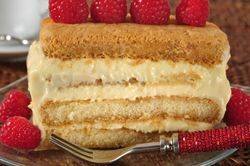
in the coffee soaking syrup. The top of the Tiramisu is garnished, first with a dusting of cocoa powder, and then
with shaved or chopped semisweet chocolate and raspberries (if they are in season).
It is a good idea to make this dessert the day before so the flavors have
time to mingle, and I also
like to place the Tiramisu in the freezer for an hour or two before serving as
this makes it much easier to slice.
Cream Topping: In a medium sized
saucepan heat 1 3/4 cups (420 ml) milk and 1/2 cup (100 grams) sugar just until
boiling. Meanwhile, in a heatproof bowl, whisk together the remaining 1/4 cup
(60 ml) milk, 1/4 cup (50 grams) sugar, flour, and egg yolks. When the milk
comes to a boil, gradually whisk it into the egg yolk mixture. Transfer this
mixture into another clean large saucepan and cook over medium heat, stirring
constantly, until it comes to a boil. When it boils, continue to whisk the
mixture constantly for another minute or so or until it thickens. Remove from
heat and strain into a large bowl. (This will remove any lumps that may have
formed.) Whisk in the Marsala (or rum), vanilla extract, and butter.
Immediately cover the surface of the custard with plastic wrap to prevent a
crust from forming. Refrigerate until cold, approximately two hours.
Once the custard
has cooled sufficiently, remove from the refrigerator. In a separate bowl, with
a wooden spoon, beat the mascarpone cheese until it is soft and smooth. Gently fold,
or whisk, the mascarpone
into the cold custard until smooth.
Coffee
Soaking Syrup: In a large
shallow bowl
combine the coffee (espresso), sugar, and rum. Taste and add more sugar if you
like. Set aside.
To Assemble: Line a
9 x 5 x 3 inch (23 x 13 x 8 cm) loaf pan with plastic wrap. Make sure the
plastic wrap extends over the sides of the loaf pan.
Have ready the ladyfingers, coffee mixture,
and cream filling.
Working
with one ladyfinger at a time, dip 8 ladyfingers in the coffee mixture and place
them side by side in a single layer over the bottom of the loaf pan. Spoon 1/3
of the cream filling over the ladyfingers, making sure they are completely
covered. Repeat with another layer of ladyfingers by dipping them (8)
ladyfingers in the coffee mixture and placing them on top of the cream. Again,
cover the ladyfingers with cream and repeat with another layer of ladyfingers,
cream, and ladyfingers. Cover the Tiramisu with plastic wrap and refrigerate at
least 6 hours, preferably overnight.
To Serve: Remove the plastic
wrap from the top of the tiramisu. Gently invert the Tiramisu from the loaf pan
onto your serving plate and
remove the plastic wrap. Sift cocoa powder over the top of the Tiramisu and
decorate with
grated or chopped semisweet chocolate and fresh raspberries (if in season).
Makes 8 - 10 servings.
Sources:
de Laurentis,
Giada. 'Everyday Italian'. Clarkson Potter/Publishers. New York: 2005.
Sax, Richard. 'Classic
Home Desserts'. Houghton Mifflin Company. New York: 1994.
Cream Filling:
2 cups
(480 ml) milk, divided
3/4 cup
(150 grams) granulated white sugar, divided
1/4 cup
(35 grams) all purpose flour
6 large
egg yolks
1/4 cup
(60 ml) dark rum or Marsala
2
teaspoons pure vanilla extract
1/4 cup
(57 grams) unsalted butter, cut into small pieces
8 ounces
(1 cup) (227 grams) mascarpone cheese
Ladyfingers:
32 crisp
ladyfingers (Savoiardi)
Coffee Soaking Syrup:
1
1/2 cups (360
ml) very strong brewed coffee
or espresso
1/3 cup (65 grams) granulated
white sugar
1/4 cup
(60 ml) dark rum or
Marsala
Topping:
Cocoa
Powder for Garnishing
1 ounce
(30 grams) semisweet or bittersweet chocolate, grated or chopped
All content on this site is
either original or has been significantly modified and changed from its
credited original source. Use of materials on Joyofbaking.com is
entirely at the risk of the user and Joyofbaking.com or Stephanie Jaworski
will not be responsible for any damages directly or indirectly resulting
from the use.
This
website and the contents thereof are not endorsed or sponsored by the owner
of the "Joy of Cooking" series of books or its publisher Simon & Schuster,
Inc.
Content in any form may
not be copied or used without written permission of Stephanie Jaworski,
Joyofbaking.com. Students and non profit educators may use content without
permission with proper credit.