If you are not of Welsh descent you may not know
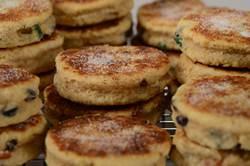
about Welsh Cakes. I think the best way to describe this delicious
tea time treat, is to say they are like a scone. Only instead of
baking them in the oven they are cooked on a griddle or in a frying
pan, which gives them a
golden brown outer crust, yet inside they are wonderfully soft. Dust
the tops with a little granulated white sugar or powdered sugar or
maybe even a slathering of butter, and then sit down and enjoy one
(or two) with a nice hot cup of tea.
When you look at this recipe you will see how
similar it is to a scone. The only real difference is that less milk is
used in the Welsh Cake batter because you want a dough that can be easily rolled
and cut into rounds. Again, as with scones they are often flavored,
and while I like to make them as my mother did, with a little ground
cinnamon and mace, feel free to leave out these spices and instead add a
little vanilla extract. Currants or raisins are most commonly added
to the dough, but I like a
combination of currants and mixed peel. (Mixed peel or candied citrus peel
is preserved fruit that has been dipped several times in a concentrated
sugar syrup. It is usually packaged in small plastic tubs.) As with a
scone dough it is important not to over work the dough as you want the
Welsh Cakes to be nice and soft inside. Now, unlike
scones that are baked in a hot oven, Welsh Cakes are cooked on a lightly
buttered griddle, electric frying pan, or in heavy bottomed frying pan (I
prefer cast iron).
Preheat the pan to medium high (350 degrees F (180 degrees C)) before greasing it with butter. Keep in mind that you may
have to adjust the heat as you go to ensure that the Welsh Cakes have a
lovely golden brown crust and are cooked all the way through. Welsh
Cakes are fully cooked when they have turned golden brown on both sides,
yet the insides of the cakes are still soft (but not doughy). A sprinkle of
granulated white sugar or powdered immediately after cooking adds a nice
touch, or they can be served plain, buttered, or with clotted cream and
jam.
Welsh Cakes: In a large
bowl, whisk together the flour, sugar, baking powder, salt, ground cinnamon, and
mace. Cut the cold butter into small pieces and blend into the flour mixture with a
pastry blender, two knives, or your fingertips. The mixture should look like coarse crumbs. Stir
in the currants and mixed peel. Add the beaten egg and enough milk to form
a soft dough.
Knead
the
dough gently on a lightly floured surface and roll to a thickness of about 1/4 inch (5
mm). Cut into rounds using a 2 1/2 inch (6 cm) cookie cutter.
Heat a griddle,
heavy bottomed frying pan, or electric frying pan to medium hot (about 350 degrees F (180
degrees C)). Lightly butter and then cook the welsh cakes for about 3 minutes
per side, or until they are golden brown, but still soft in the middle.
Immediately after baking, sprinkle with granulated white sugar or powdered
sugar. Serve warm or at room temperature. Welsh Cakes can be covered and stored
at room temperature for several days or they can be frozen.
Makes about 20 - 2
1/2 inch cakes.
Note: Welsh
Cakes can also be baked in a 350 degree F (177 degree C) oven. Place on a
parchment paper lined baking sheet and bake
until set and very lightly browned yet still soft inside (they won't get as
brown as when you cook them on a griddle). They can also be
cooked on a baking stone in the oven. Heat the stone in a 350 degree F
(177 degree C) oven and then bake the Welsh Cakes on the stone.
Note: Mixed peel or candied citrus peel is preserved fruit that has
been dipped several times in a concentrated sugar syrup. It is usually
packaged in small plastic tubs.
References
cited may include a link to purchase the referenced book on Amazon.com.
Joyofbaking.com receives a commission on any purchases resulting from these
links.
This
website and the contents are not endorsed or sponsored by the owner of the
"Joy of Cooking" series of books or its publisher Simon & Schuster, Inc.
Video icons by Asher.
Content in any form may
not be copied or used without written permission of Stephanie Jaworski,
Joyofbaking.com. Students and non profit educators may use content without
permission with proper credit.