My idea of the perfect weekend breakfast is a
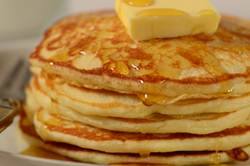
stack of Pancakes with
butter and maple syrup dripping down its sides. I love how Pancakes use the most
basic of ingredients. Just flour, sugar, salt, baking powder, an egg, a
little butter, and milk. Like a muffin batter, just two bowls are needed.
One for the dry ingredients, and one for the wet ingredients. Then the two are
simply stirred together and the pancake batter is ready to be ladled onto
a hot skillet.
Pancakes can be
made in any size and shape, ranging from the size of a
silver dollar to a round as large as your pan. You will know it is time to
turn your pancake when the top surface begins to form small craters.
Continue to cook the pancake until both sides have turned golden
brown and it is cooked all the way through. Some say you should only flip
a pancake once, but that is an old wives' tales. If you are not
serving the pancakes immediately, place them in a warm
oven (175 degrees F (80 degrees C)) directly on the wire rack. I do not like to stack the pancakes until
serving as this will make them soggy, which will never do. While
butter and maple syrup are the proverbial favorite, pancakes are also good with
jam, fresh berries and whipped cream, or with just a dusting of icing
sugar.
What is interesting about a pancake batter is that by changing the
proportions of dry to wet ingredients you can change the thickness of the
batter. Pancakes are known around the world by different names. If we make a thin pancake batter
they are known in different countries as French crepes, blintz, Chinese pancakes (Bao bing) and
a Hungarian palacsinta. A thicker batter makes an American pancake
(also known as griddle cakes or flapjacks (meaning "to flip")), an Australian pikelet, a Scotch
pancake or a drop scone. Both types of batters produce a pancake
that is light and fluffy with a soft crust and
spongy texture.
Although pancakes are mainly served for
breakfast they take center stage on Pancake Day, or Shrove Tuesday (Mardi
Gras), when they are served for supper. The ingredients used to make
pancakes (flour, sugar, butter, milk and eggs) are forbidden during Lent so this is considered a 'feast' before
a 'fast'. It is interesting to note that the word 'Shrove' comes
from the word 'shrive' which is the Tuesday before Lent and the day on
which parishioners shrive, or confess, their sins.
Pancake Recipe: In a large bowl whisk together the
flour, baking powder, salt and sugar. In a separate bowl whisk together the
egg, milk, and melted butter. Make a well in the center of the dry ingredients
and then pour in the egg mixture, all at
once, and stir (with a rubber spatula or wooden spoon) just until combined. The batter should have some small
lumps. (Do not over
mix the batter or the pancakes will be tough.)
Heat a frying pan or griddle over
medium high heat until a few sprinkles of water dropped on the pan or griddle splatter.
Adjust the temperature as needed. Can also use an electric griddle with the
temperature set at 350 degrees F (180 degrees C). Using a piece of paper towel
or a pastry brush, lightly brush the pan with melted butter or oil (or spray
with a non stick vegetable spray.)
Using a small ladle or
scoop, pour about 1/4 cup (60 ml) of pancake batter onto the hot pan, spacing
the pancakes a few inches apart. When the bottoms of the pancakes are brown and
bubbles start to appear on the top surfaces of the pancakes (2-3 minutes), turn
over. Cook until lightly browned (about 1-2 minutes).
Repeat with remaining
batter, brushing the pan with melted butter or oil between batches.
Serve immediately
with butter and maple syrup.
Makes about 8 - 4 inch (10 cm) pancakes. Serves 3-4
people.
For Blueberry Pancakes:
Sprinkle fresh or frozen blueberries (prefer wild blueberries) on the tops of the pancakes just as bubbles
start to appear on the top surface of the frying batter. Preparation time 15
minutes.
Use of materials on
all pages on the domains Joyofbaking.com,
the Joyofbaking.com Facebook
Page, the
Joyofbaking1 YouTube
Channel and any emails sent from @joyofbaking.com
are
entirely at the risk of the user and their owner, iFood Media LLC
will not be responsible for any damages directly or indirectly resulting
from the use.
References
cited may include a link to purchase the referenced book or item on Amazon.com.
Joyofbaking.com receives a commission on any purchases resulting from these
links.
This
website and the contents are not endorsed or sponsored by the owner of the
"Joy of Cooking" series of books or its publisher Simon & Schuster, Inc.
and is not related to the "Joy the Baker" books and website.
Video icons by Asher.
Content in any form may
not be copied or used without written permission of Stephanie Jaworski,
Joyofbaking.com. Students and non profit educators may use content without
permission with proper credit.