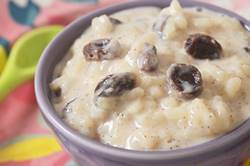
I think of Rice Pudding as comfort food.
Comfort food should be simple to make, using the most basic of ingredients
that you already have in the house. And it definitely has to taste good. Interestingly enough, although sweetened
milk seems to be the basis for a lot of rice pudding recipes, country and culture
does influence what type of rice and milk to use and also what spices (nutmeg, mace, and cinnamon) and flavorings (such
as rose water, vanilla, orange and lemon peel) are added to the pudding.
The question of which rice to use is debatable as
there are many choices; long or short grain white rice, basmati, or even
jasmine. My personal preference is to use either a long or short grain
white rice. The difference being that long grain rice will produce a
pudding that is slightly drier and chewier than one made with a short
grain rice. You use a very small amount
of rice to milk in this pudding. And that is because the
rice expands and the milk reduces during cooking so don't be tempted to
use extra rice. The pudding should be cooked until the rice is al dente,
that is, just tender, which takes about
20 to 25 minutes. Then remove from heat and stir in the sugar,
cinnamon, and raisins (if using). Return to heat and simmer just until the
pudding starts to thicken. The final step is to stir in the vanilla
extract.
Lastly,
there is always the question of whether there should or should not be a film
(skin) on
top of the pudding. This is a personal choice. If you don't like the film then press plastic wrap directly on the surface of the pudding right after it
is cooked. Leaving the rice pudding uncovered until it has
cooled will produce the skin (film). Rice Pudding is delicious hot, lukewarm, or even cold.
Rice Pudding: In a medium heavy bottomed
saucepan combine the milk, rice, and salt. Place the saucepan over medium high heat
and bring to a boil. Reduce the heat to a simmer
and cook until the rice is tender (about 20 to 25 minutes). Stir the milk mixture
frequently using a heatproof spatula or wooden spoon to prevent the rice
from sticking to the bottom of the pan. When the rice
is tender (al dente) remove from heat and add the sugar,
ground cinnamon, and raisins (if using).
Return to heat and cook until the rice pudding
starts to thicken,
about 5 to 10 minutes. Remove from heat and
stir in the vanilla extract, if using. Spoon the
pudding into your serving bowls and cover with plastic wrap. If you want a
film or skin on the puddings, allow them to cool before covering with plastic
wrap. If not serving right away, refrigerate. Rice Pudding can be served
hot, warm, or cold.
If desired, garnish with
lightly sweetened whipped cream.
Use of materials on
all pages on the domains Joyofbaking.com,
the Joyofbaking.com Facebook
Page, the
Joyofbaking1 YouTube
Channel and any emails sent from @joyofbaking.com
are
entirely at the risk of the user and their owner, iFood Media LLC
will not be responsible for any damages directly or indirectly resulting
from the use.
References
cited may include a link to purchase the referenced book or item on Amazon.com.
Joyofbaking.com receives a commission on any purchases resulting from these
links.
This
website and the contents are not endorsed or sponsored by the owner of the
"Joy of Cooking" series of books or its publisher Simon & Schuster, Inc.
and is not related to the "Joy the Baker" books and website.
Video icons by Asher.
Content in any form may
not be copied or used without written permission of Stephanie Jaworski,
Joyofbaking.com. Students and non profit educators may use content without
permission with proper credit.